We’ve previously featured a series of remarkable little films of French artists Pierre-Auguste Renoir, Claude Monet and Edgar Degas. Here we wrap things up with just one more: a rare glimpse of the great sculptor Auguste Rodin.
The footage was taken in 1915, two years before Rodin’s death. There are several sequences. The first shows the artist at the columned entrance to an unidentified structure, followed by a brief shot of him posing in a garden somewhere. The rest of the film, beginning at the 53-second mark, was clearly shot at the palatial, but dilapidated, Hôtel Biron, which Rodin was using as a studio and second home.
The mansion was built as a private residence in the early 18th century, and served as a Catholic school for girls from 1820 until about 1904, when it became illegal for public money to be used for religious education. When the last of the nuns cleared out, the rooms of the Hôtel Biron were rented out to a diverse group of people that included some notable artists: Jean Cocteau, Isadora Duncan, Henri Matisse and Rainer Maria Rilke, who served for a time as Rodin’s secretary. It was Rilke’s wife, the sculptor Clara Westhoff Rilke, who first told Rodin about the place in 1909.
Rodin first rented four rooms on the main floor, but was alarmed when he learned of plans to sell the property off in pieces to developers. So he made a deal with the government: In exchange for bequeathing all his works to the French state, the sculptor was allowed to occupy the mansion for the rest of his life, and after he died, the estate would become the Musée Rodin.
By the time actor Sacha Guitry and his cameraman arrived to film this scene from Ceux de Chez Nous, or “Those of Our Land,” Rodin was the sole occupant of the Hôtel Biron. The film shows the 74-year-old artist walking down the weed-covered steps of the mansion and working inside, chipping away at a marble statue with a hammer and chisel. When Rodin was asked once about how he created his statues, he said, “I choose a block of marble and chop off whatever I don’t need.”
Note: An earlier version of this post appeared on our site in 2012.
If you would like to support the mission of Open Culture, consider making a donation to our site. It’s hard to rely 100% on ads, and your contributions will help us continue providing the best free cultural and educational materials to learners everywhere. You can contribute through PayPal, Patreon, and Venmo (@openculture). Thanks!
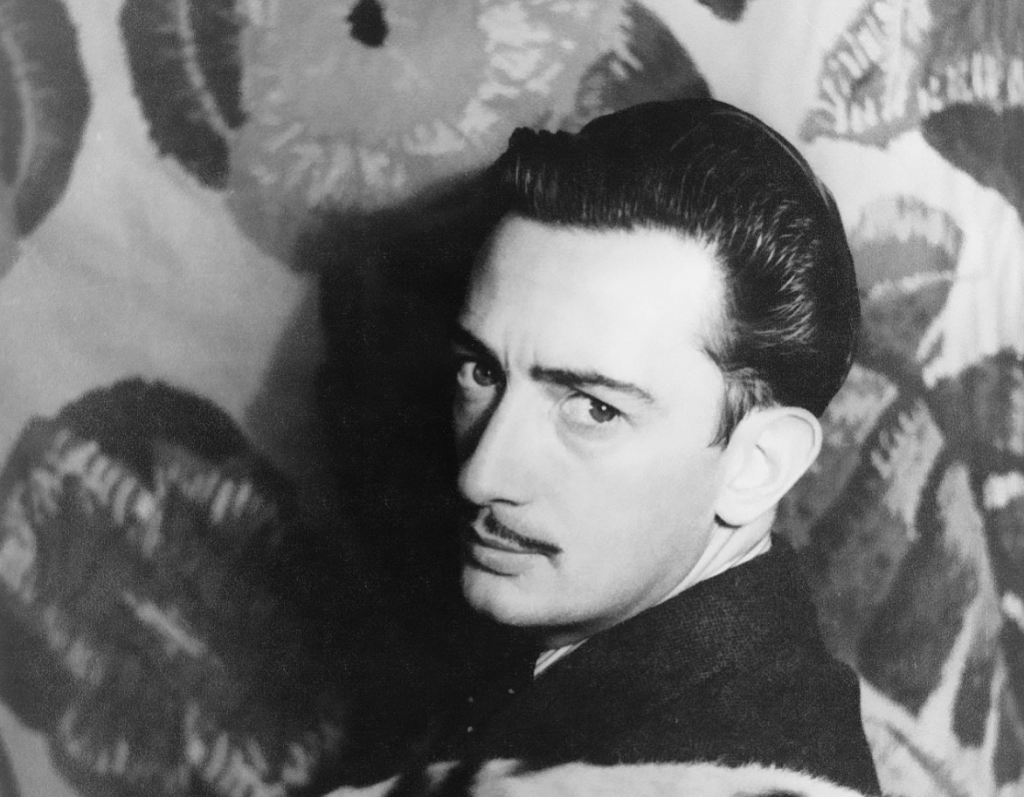
We may be conditioned to offering an opinion at the push of a button, but before venturing on the question of whether we can, or should, separate the art from the artist, it seems ever prudent to ask, “Which art and which artist?” There are the usual case studies, in addition to the crop of disgraced celebrities: Ezra Pound, P.G. Wodehouse, and, in philosophy, Martin Heidegger. One case of a very troubling artist, Salvador Dalí, gets less attention, but offers us much material for consideration, especially alongside an essay by George Orwell, who ruminated on the question and called Dalí both “a disgusting human being” and an artist of undeniably “exceptional gifts.”
Like these other figures, Dalí has long been alleged to have had fascist sympathies, a charge that goes back to the 1930s and perhaps originated with his fellow Surrealists, especially André Breton, who put Dalí on “trial” in 1934 for “the glorification of Hitlerian fascism” and expelled him from the movement. The Surrealists, most of whom were communists, were provoked by Dalí’s disdain for their politics, expressed in the likeness of Lenin in The Enigma of William Tell. It’s also true that Dalí seemed to publicly profess an admiration for Hitler. But as with everything he did, it’s impossible to tell how seriously we can take any of his pronouncements.
Another painting, 1939’s The Enigma of Hitler is even more ambiguous than The Enigma of William Tell, a collection of dream images, with the recurring melting objects, crutches, mollusk shells, and food images, set around a tiny portrait of the German dictator. Kamila Kocialkowska suggests that psychoanalytic motifs in the painting, some rather obvious, reflect Hitler’s “fear of impotence, and certain commentators have noted that Hitler’s enthusiastic promotion of nationalistic breeding can further explain the innuendo present in this image.”
The Hitler obsession began years earlier. “I often dreamed of Hitler as a woman,” Dalí supposedly said,
His flesh, which I imagined as whiter than white, ravished me. I painted a Hitlerian wet nurse sitting kneeling in a puddle of water….
There was no reason for me to stop telling one and all that to me Hitler embodied the perfect image of the great masochist who would unleash a world war solely for the pleasure of losing and burying himself beneath the rubble.
The painting Dalí alludes to, The Weaning of Furniture-Nutrition, is the work that first raised Breton’s ire, since “Dalí had originally painted a swastika on the nurse’s armband,” notes art historian Robin Adèle Greeley, “which the Surrealists later forced him to paint out.” Dalí later claimed that his Hitler paintings “subvert fascist ideologies,” Greeley writes: “Breton and company appear not to have appreciated a fellow Surrealist suggesting that there were connections to be made between bourgeois childhoods such as their own and the family life of the Nazi dictator.” Likewise, his creepy dream-language above is hardly more straightforward than the paintings, though he did write in The Unspeakable Confessions of Salvador Dalí, “Hitler turned me on in the highest.”
Other pieces of evidence for Dalí’s politics are also compelling but still circumstantial, such as his friendship with the proudly professed Nazi-sympathizer, Wallis Simpson, the American Duchess of Windsor, and his admiration for Spanish dictator Francisco Franco, whom he called, as Lauren Oyler points out at Vice, “the greatest hero of Spain.” (Dalí painted a portrait of Franco’s daughter). Oyler points out that Dalí’s “wickedness,” as Orwell put it in his scathing review of the artist’s “autobiography” (a spurious category in the case of serial fabricator Dalí), matters even if it were pure provocation rather than genuine commitment.
The claim carries more weight when applied to the artist’s attested sadism in general. Dalí spends a good part of his Confessions delighting in stories of brutal physical and sexual assault and cruelty to animals. (The famous Dalí Atomicus photo, his collaboration with Philippe Halsman, required 28 attempts, Oyler notes, and “each of those attempts involved throwing three cats in the air and flinging buckets of water at them.”) Whether or not Dalí was a genuine Nazi sympathizer or an amoral right-wing troll, Orwell is completely unwilling to give him a pass for generally cruel, abusive behavior.
“In his outlook,” writes Orwell, “his character, the bedrock decency of a human being does not exist. He is as anti-social as a flea. Clearly, such people are undesirable, and a society in which they can flourish has something wrong with it.” But perhaps Dalí means to say exactly that. Allowing for the possibility, Orwell is also unwilling to toss aside Dalí’s work. The artist, he writes “has fifty times more talent than most of the people who would denounce his morals and jeer at his paintings.”
When it comes to the question of Dalí as fascist, some less-than-nuanced views of his work (“Marxist criticism has a short way with such phenomena as Surrealism,” writes Orwell) might miss the mark. The Weaning of Furniture-Nutrition, writes Greeley, seems to reveal “a secret about his own middle-class background” as a nursery for fascism, especially given the “disturbing” fact that “the nurse is a portrait of Dalí’s own, and that she droops hollowly on the shore near the painter’s Catalan childhood home, suggesting that Dalí himself might have had a ‘hitlerian’ upbringing.”
Greeley’s further elaboration on Dalí’s conflict with Breton further weakens the charges against him. “Ten days before the February meeting, he had defended himself to Breton,” she writes, “claiming, ‘I am hitlerian neither in fact nor in intention.’ ” He pointed out that the Nazis would likely burn his work, and chastised leftists for “their lack of insight into fascism.”
The question of Dalí’s fascist sympathies is incoherent without the biography, and the biographical evidence against Dalí seems fairly thin. Nonetheless, he has emerged from history as a violent, vicious, opportunistic person. How much this should matter to our appreciation of his art is a matter you’ll have to decide for yourself.
Note: An earlier version of this post appeared on our site in 2018.
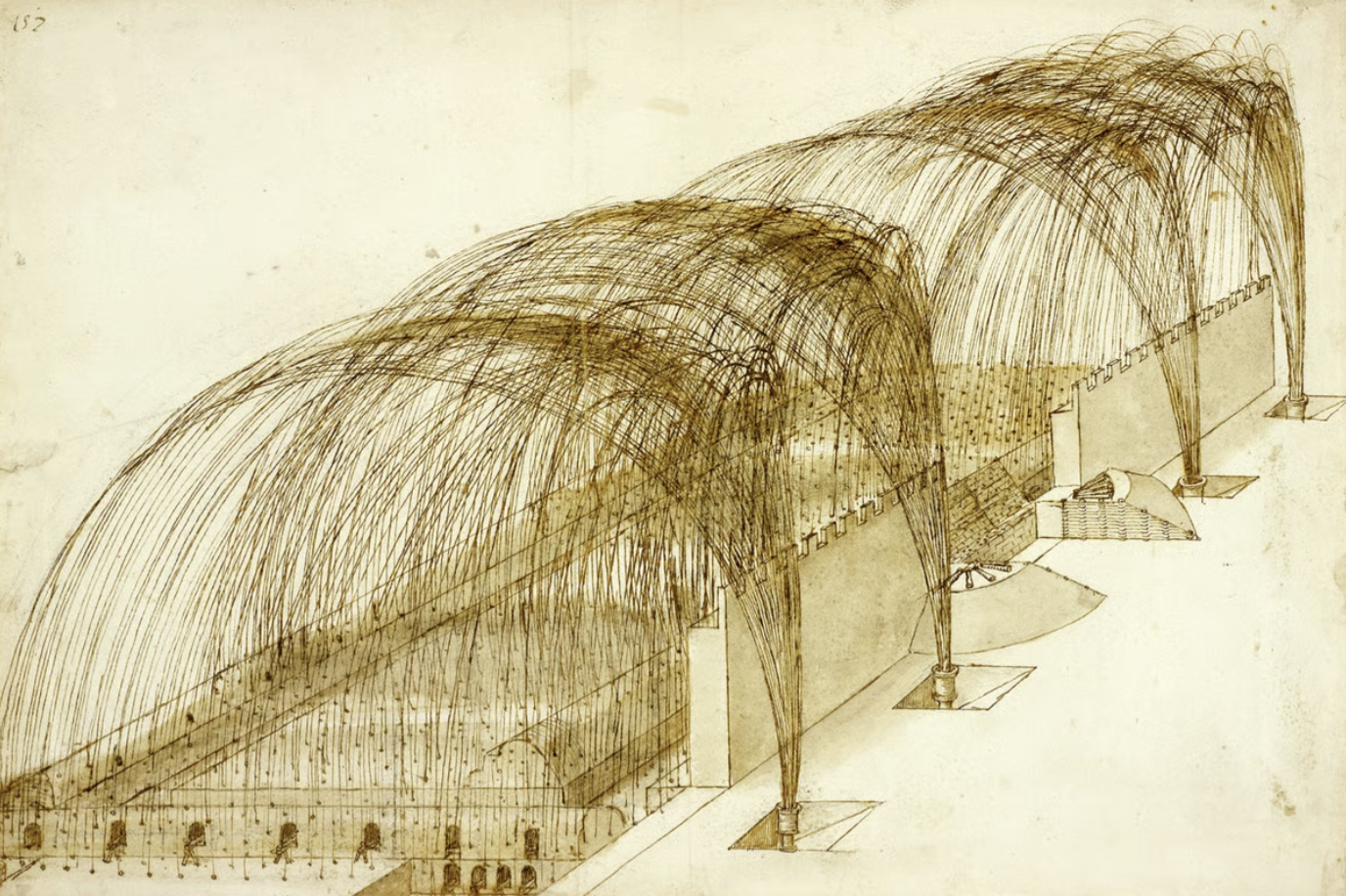
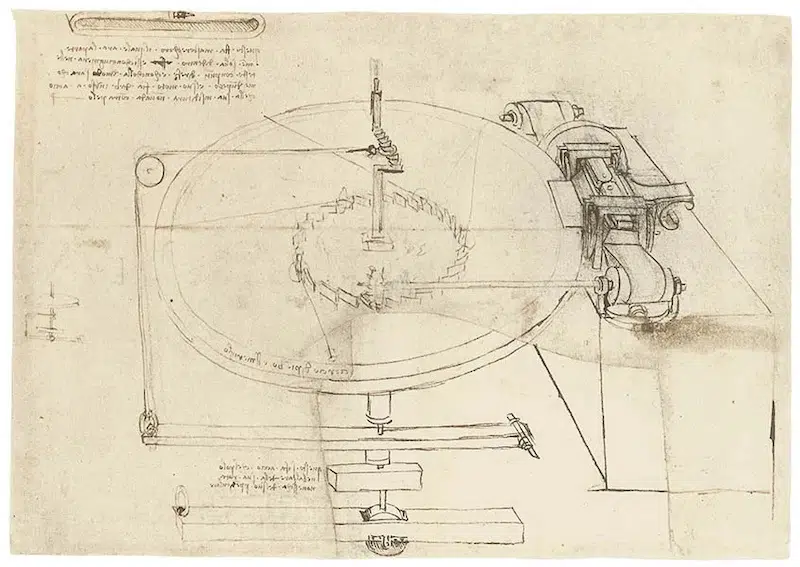
Leonardo da Vinci was a painter, draughtsman, engineer, scientist, theorist, sculptor, and architect, to provide only his most widely agreed-upon list of occupations. It is he, more than any other single figure, who comes to mind when we think of the ideal of the “Renaissance man.” Though considered rather less practical today than it was in fifteenth-century Italy, the relentless questing for both scientific knowledge and artistic perfection implied by that title has never entirely ceased to appeal. For aspiring modern Renaissance men, one of the most enduring sources of inspiration remains Leonardo’s own notebooks, full of backwards-written explorations of ideas both realized and unrealized that move unpredictably from one intellectual domain to another.
That last quality seems to have displeased the sculptor Pompeo Leoni, who eventually came into possession of Leonardo’s notebooks after they were inherited by his last student Francesco Melzi. Leoni “dismounted and cut the folios, separating the materials into two albums according
to his own judgement,” notes the Italian Embassy in London, “the larger portion for technical and scientific topics,” and the smaller for “Leonardo’s artistic and figurative workings.”
In the early seventeenth century, Leoni’s son-in-law sold the former album, now known as the Codex Atlanticus, to a count who in turn donated it to the Veneranda Biblioteca Ambrosiana; the latter ended up in England’s Royal Collection by 1670 or so. Only now have they been reunited, thanks to a project called Leonardotheka.
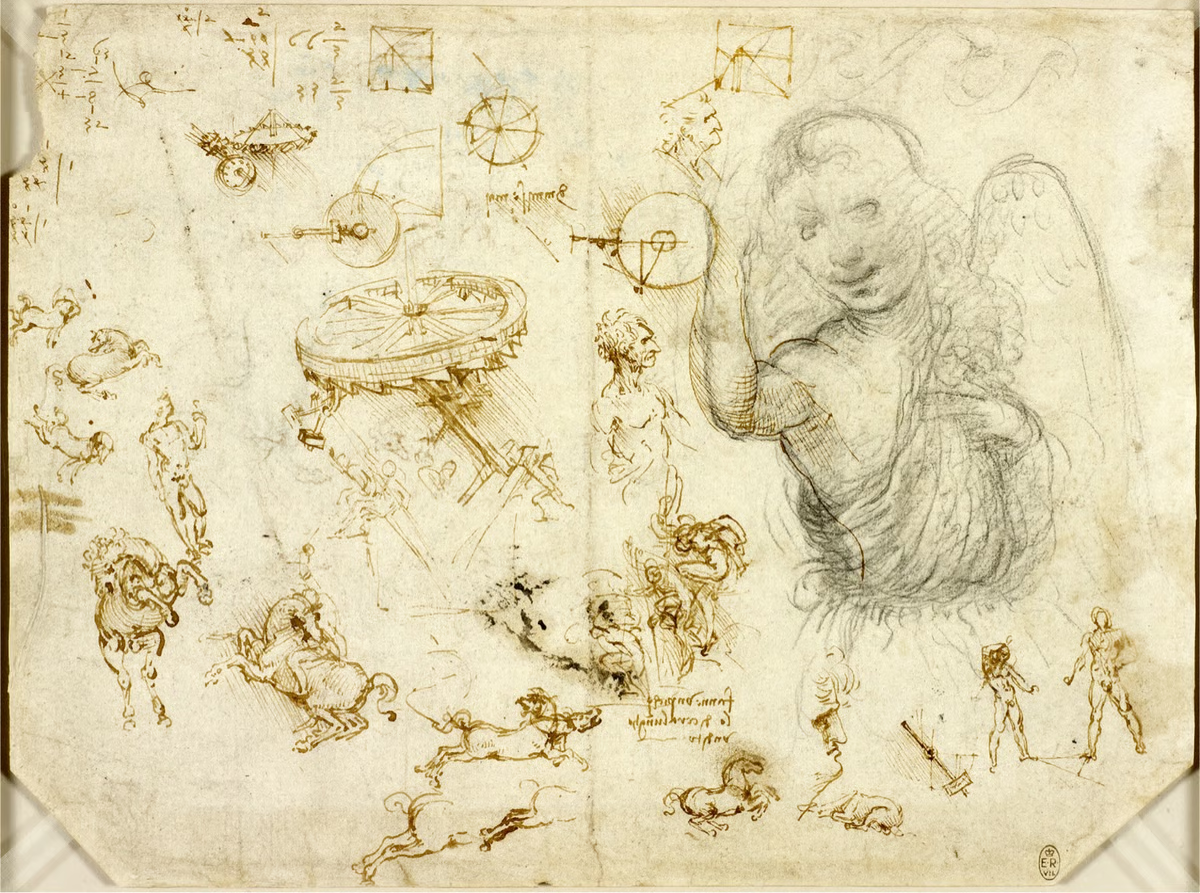
The culmination of a decade’s work involving the Veneranda Biblioteca Ambrosiana as well as the Biblioteca Leonardiana and the Royal Collection Trust, Leonardotheka digitally reunites those albums after four centuries apart. Such a task also entailed the reconstruction of 50 long-sundered individual pages and their replacement into their original context. The notebooks combined “decades of anatomical studies, flying machines, landscapes, and grocery-list-adjacent musings, all tangled together the way Leonardo’s mind may have worked,” writes Anastasia Scott at Discover. Yet he’d “likely never intended to separate art from science in the first place. A single page might hold a machine, a horse, and a poem, and Leoni severed connections the artist had made on purpose.” With those connections restored, we here in the twenty-twenties — a time plagued by its own doubts about the relationship between what we now call “humanities” and “STEM” — can see once again how a real Renaissance mind worked. Enter the Leonardothekahere.
Based in Seoul, Colin Marshall writes and broadcasts on cities, language, and culture. He’s the author of the newsletterBooks on Cities as well as the books 한국 요약 금지 (No Summarizing Korea) and Korean Newtro.Follow him on the social network formerly known as Twitter at @colinmarshall.
They do, just not often or well. Their meals rarely rate recipes, let alone cookbooks.
Those cookbooks do exist though.…
The mostly conceptual Starving Artist Cookbook put together by EIDIA (aka artists Paul Lamarre and Melissa Wolf) comes close to the spirit of sustaining life through meager ingredients… like spaghetti or 4 pages of shredded Pravda.
Not so this other title, which approaches cute overload with an abundance of Instagram-worthy illustrated fare—mojitos, an unstructured berry tart, a “manly” burger.…
Do “starving” artists no longer fear being outed as posers?
Successful artists may not worry about that, as they eat whatever and however they want.
So seriously, their culinary efforts led to cookbooks, which the Art Assignment’s host, curator Sarah Urist Green, tried out on camera.
O’Keeffe, who grew up in Wisconsin on homemade yogurt, homemade cheese, and plentiful homegrown produce, ground her own flour in order to bake daily loaves of whole wheat bread.
Green treats viewers to a brief overview of O’Keeffe’s life and work as she struggles with the grinder. (You might get the same, or better, results if you take a $5 bill to a good bakery right at opening.)
She also tackles the wheat germ Tiger’s Milk smoothie advocated by Adelle Davis, a nutritionist whom O’Keeffe admired, and Green Chiles with Garlic and Oil and Fried Eggs, using recipes from the cookbooks A Painter’s Kitchen and Dinner with Georgia O’Keeffe.
Before attempting the same, you might want to watch the Kahlo-centric episode, above, in which Green discovers a much better method for roasting the poblano peppers she haplessly substituted for New Mexico chiles in O’Keeffe’s egg dish.
Here, they’re used for Chiles Rellenos, a dish whose pronunciation the self-effacing Green butchers, along with a multitude of other Spanish phrases, a fact not lost on the video’s Youtube commenters. They also take issue with the presence of plantains, her preparation of the Nopales Salad, and her cooking skills in general. No wonder Green—a self-proclaimed wussy where serranos are concerned—seems so eager to reach for a shot of tequila as dinner is finally served.
Kahlo herself learned to cook from her mother’s copy of El Nuevo Cocinero Mejicano, and from husband Diego Rivera’s first wife, Guadalupe (leading one to wonder if some of that cookbook’s recipes aren’t misattributed to the more famous cook).
As with the O’Keeffe video and the cookbooks cited herein, there’s a wealth of vintage photos and reproduced artwork on display.
Even though Green alludes to Kahlo’s dark side, sensitive stomachs might have trouble with the inclusion of the graphically violent Unos Quantos Piquetitos. Another painting, My Nurse and I is at least related to eating, if not cooking and recipes.
At one time or another, we all feel twinges of anxiety about what will constitute the legacy we leave behind. Jerry Gretzinger may well be subject to just the same discomfort, but at least he can point to the Map: an enormous representation, made of thousands and thousands of individually created and continually modified panels, of an entirely fictional land called Ukrania. You can see Jerry’s Map painstakingly laid out in its most up-to-date state in the new People Make Games video above. As interesting as the product is so far, the work that goes into it is just as compelling, which Gretzinger performs every day according to a complex and strictly defined set of procedures dictated by a deck of heavily modified playing cards.
It would take an astute listener to grasp the rules of the project the first time through, but they’re also available for supplementary study at the official site of Gretzinger’s map. They may bring to mind Brian Eno’s Oblique Strategies, the deck of cards printed with suggestions meant to dislodge creative jams in the music studio or elsewhere.
The map itself may look more reminiscent of the work of Henry Darger, another “outsider artist” who produced riots of color and haphazard-looking materials with an obsessive underlying order of their own. But unlike Darger, who died in obscurity only for his askew epics to be discovered among his belongings, Gretzinger has become famous for his creation in his lifetime, so much so that there exists an active subreddit of amateurs following his example.
Still, the Map did first have to be rediscovered. What Gretzinger began as the expansion of idle doodles in urban form made during breaks at the ball bearing factory in 1963 had to be shelved in the eighties, when a clothing business he’d started with his wife took off. A couple of decades thereafter, his son’s discovery of the Map in the attic inspired Gretzinger to resume work on it, which has continued apace ever since. When interviewed, he sounds less like a creator than an observer, helplessly watching as the city of Ukrania becomes more abstract as it grows — and as great swathes are inexorably consumed by a white space, made of scraps of his own correspondence and other life artifacts, that he portentously calls “the Void.” Now that he’s in his mid-eighties, Gretzinger appears to find it all more freighted with meaning than ever. Sooner or later, alas the Void comes for us all; what’s left to us is how we prepare for it.
Based in Seoul, Colin Marshall writes and broadcasts on cities, language, and culture. He’s the author of the newsletterBooks on Cities as well as the books 한국 요약 금지 (No Summarizing Korea) and Korean Newtro.Follow him on the social network formerly known as Twitter at @colinmarshall.
Have you ever wondered what it would be like to travel back in time and look over the shoulder of one of the early 20th century’s greatest artists to watch him work? In this brief film from 1926, we get to see the Russian painter Wassily Kandinsky as he turns a blank canvas into one of his distinctive abstract compositions.
The film was made at the Galerie Neumann-Nierendorf in Berlin by Hans Cürlis, a pioneer in the making of art documentaries. At the time, Kandinsky was teaching at the Bauhaus. It was the same year he published his second major treatise, On Point and Line to Plane. The contrasting straight lines and curves that Kandinsky paints in the movie are typical of this period, when his approach was becoming less intuitive and more consciously geometric.
Kandinsky believed that an artist could reach deeper truths by dispensing with the depiction of external objects and by looking within, and despite his analytic turn at the Bauhaus he continued to speak of art in deeply mystical terms. In On Point and Line to Plane, Kandinsky writes:
The work of Art mirrors itself upon the surface of our consciousness. However, its image extends beyond, to vanish from the surface without a trace when the sensation has subsided. A certain transparent, but defininite glass-like partition, abolishing direct contact from within, seems to exist here as well. Here, too, exists the possibility of entering art’s message, to participate actively, and to experience its pulsating life with all one’s senses.
Note: An earlier version of this post appeared on our site in 2012.
In a way, it always made sense that one of the most memorable visual distillations of Southern California life would have been painted by an Englishman. The purest appreciation for the wide-open lifestyle choices, freestyle built environment, unrepentant private wealth, and high-wattage sunshine of Los Angeles — especially as it was exaggerated, and indeed mythologized, in mid-twentieth century popular culture — could only be felt by someone from an infinitely more traditional, straitened, and damp part of the world. David Hockney, who died last week, wasn’t just an Englishman but a northern Englishman, who would have grown up surrounded by the kind of attitudes satirized in the “Four Yorkshiremen” sketch made famous by Monty Python. Little wonder he fell in love with the newest city of the New World.
Hockney gave that many artistic forms over decades of his long life and career. Practically anyone who knows his name can recognize A Bigger Splash, from 1967, a both idyllic and faintly eerie depiction of someone having just plunged into the swimming pool behind what now looks like a classic “midcentury modern” home accented with palm trees.
But fewer can call to mind the works from which it evolved, A Little Splash and The Splash, both of which Hockney painted the previous year; all together, they constitute a series originally inspired by a photograph on the cover of a swimming-pool maintenance guide from the late fifties. You can see the three paintings put in context in the Sotheby’s video at the top of the post, which reveals how Hockney’s image grew more abstracted, and more Los Angelized, with each iteration.
When it came time to paint the third version, Hockney first built up its arrangement of house, pool, diving board, and sky with blocks of flat (if characteristically bright) color. He then gradually nudged these shapes toward representation by adding detail. Discussing the making of the painting later in life, he liked to mention how much time he spent on the splash alone: a full week, at least, to render an event that lasts no longer than a second or two. There would be more Hockney swimming pools, each evocative in its own way, none more expensive than the nearly photorealistic Portrait of an Artist (Pool with Two Figures), from 1971, which went for $90.3 million at Christie’s in 2018. But it was only A Bigger Splash that went on to adorn the cover of Reyner Banham’s Los Angeles: The Architecture of Four Ecologies, still one of the most perceptive books about that city — and one written, naturally, by another besotted Brit.
Based in Seoul, Colin Marshall writes and broadcasts on cities, language, and culture. He’s the author of the newsletterBooks on Cities as well as the books 한국 요약 금지 (No Summarizing Korea) and Korean Newtro.Follow him on the social network formerly known as Twitter at @colinmarshall.
If you’ve taken a good art history course on the Impressionists and Post-Impressionists, you’ve inevitably encountered Vincent van Gogh’s 1889 masterpiece “Starry Night,” which now hangs in the MoMA in New York City. The painting, the museum writes on its website, “is a symbolic landscape full of movement, energy, and light. The quietness of the village contrasts with the swirling energy of the sky.… Van Gogh’s impasto technique, or thickly applied colors, creates a rhythmic effect—the picture seems to constantly move in its frame.” Artistically, van Gogh managed to capture movement in a way that no artist had ever quite done it before. Scientifically, it turns out, he was on to something too. Just watch the new TED-ED lesson above, The Unexpected Math Behind Van Gogh’s “Starry Night.”
Created by math artist/teacher Natalya St. Clair and animator Avi Ofer, the video explores how “Van Gogh captured [the] deep mystery of movement, fluid and light in his work,” and particularly managed to depict the elusive phenomenon known as turbulence. In Starry Night, the video observes, van Gogh depicted turbulence with a degree of sophistication and accuracy that rivals the way physicists and mathematicians have best explained turbulence in their own scientific papers. And, it all happened, perhaps by coincidence (?), during the turbulent last years of van Gogh’s life.
Note: An earlier version of this post appeared on our site in 2014.
If you would like to support the mission of Open Culture, consider making a donation to our site. It’s hard to rely 100% on ads, and your contributions will help us continue providing the best free cultural and educational materials to learners everywhere. You can contribute through PayPal, Patreon, and Venmo (@openculture). Thanks!
We're hoping to rely on loyal readers, rather than erratic ads. Please click the Donate button and support Open Culture. You can use Paypal, Venmo, Patreon, even Crypto! We thank you!
Open Culture scours the web for the best educational media. We find the free courses and audio books you need, the language lessons & educational videos you want, and plenty of enlightenment in between.