In 1929, the book publisher George Macy founded The Limited Editions Club (LEC), an imprint tasked with publishing finely illustrated limited editions of classic books. In the years to come, Macy worked with artists like Matisse and Picasso, and photographers like Edward Weston, to produce books with artistic illustrations on their inner pages. And sometimes The Limited Editions Club even turned its design focus to other parts of the book. Take for example this 1946 edition of Edward Gibbon’s The Decline and Fall of the Roman Empire and its pretty amazing spine design.
Created by Clarence P. Hornung, the design captures the essence of Gibbon’s classic, showing Roman pillars progressively crumbling as your eyes move from Volume 1 to Volume 7. George Macy later called the collection, which also features illustrations by the great 18th-century printmaker Giovanni Battista Piranesi, “the most herculean labor of our career.”
Note: an earlier version of this post appeared on our site in June 2015.
If you would like to support the mission of Open Culture, consider making a donation to our site. It’s hard to rely 100% on ads, and your contributions will help us continue providing the best free cultural and educational materials to learners everywhere. You can contribute through PayPal, Patreon, and Venmo (@openculture). Thanks!
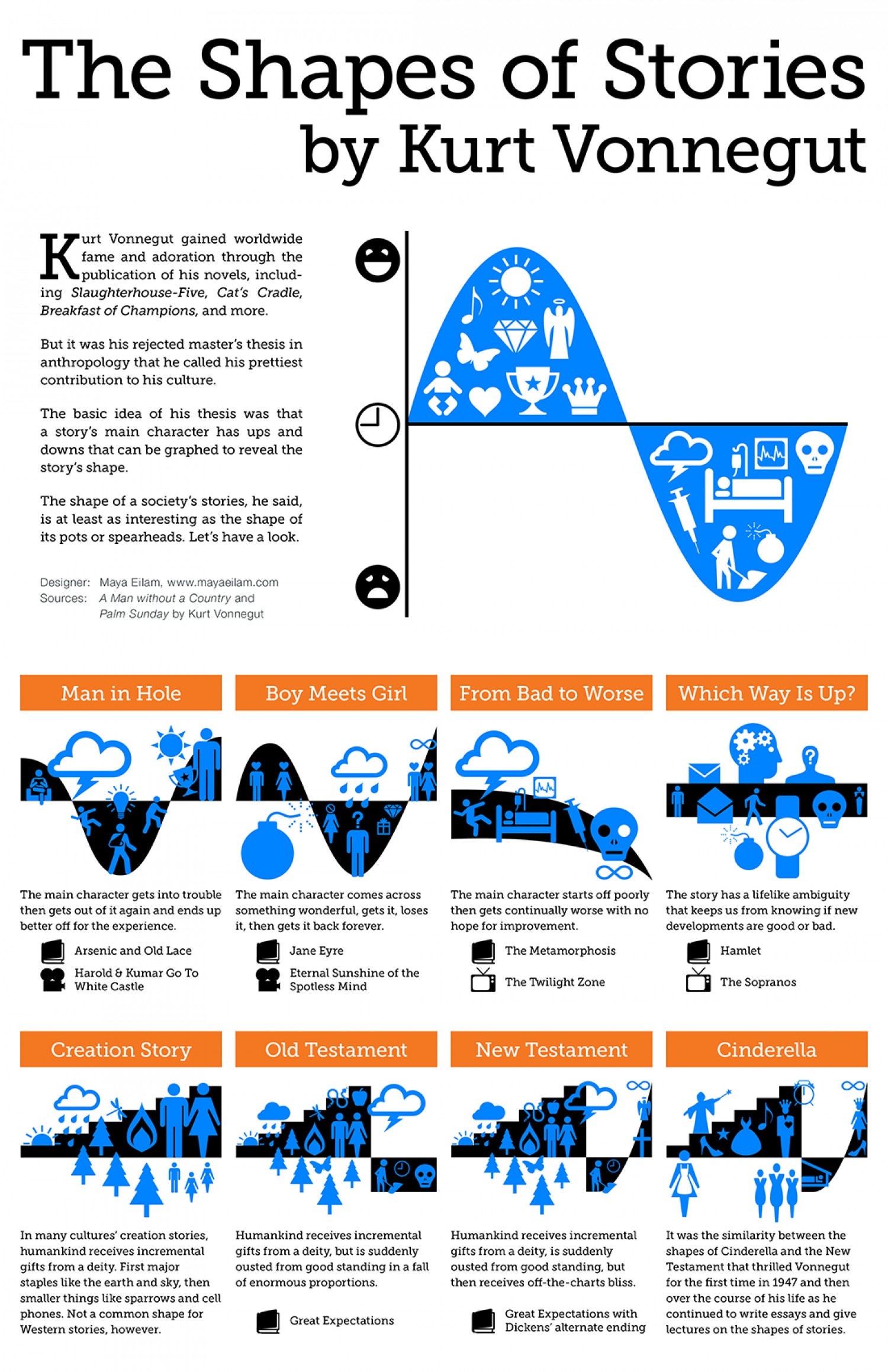
“What has been my prettiest contribution to the culture?” asked Kurt Vonnegut in his autobiography Palm Sunday. His answer? His master’s thesis in anthropology for the University of Chicago, “which was rejected because it was so simple and looked like too much fun.” The elegant simplicity and playfulness of Vonnegut’s idea is exactly its enduring appeal. The idea is so simple, in fact, that Vonnegut sums the whole thing up in one elegant sentence: “The fundamental idea is that stories have shapes which can be drawn on graph paper, and that the shape of a given society’s stories is at least as interesting as the shape of its pots or spearheads.” In 2011, we featured the video below of Vonnegut explaining his theory, “The Shapes of Stories.” We can add to the dry wit of his lesson the picto-infographic by graphic designer Maya Eilam above, which strikingly illustrates, with examples, the various story shapes Vonnegut described in his thesis. (Read a condensed version here.)
The presenter who introduces Vonnegut’s short lecture tells us that “his singular view of the world applies not just to his stories and characters but to some of his theories as well.” This I would affirm. When it comes to puzzling out the import of a story I’ve just read, the last person I usually turn to is the author. But when it comes to what fiction is and does in general, I want to hear it from writers of fiction. Some of the most enduring literary figures are expert writers on writing. Vonnegut, a master communicator, ranks very highly among them. Does it do him a disservice to condense his ideas into what look like high-res, low-readability workplace safety graphics? On the contrary, I think.
Though the design may be a little slick for Vonnegut’s unapologetically industrial approach, he’d have appreciated the slightly corny, slightly macabre boilerplate iconography. His work turns a suspicious eye on overcomplicated posturing and champions unsentimental, Midwestern directness. Vonnegut’s short, trade publication essay, “How to Write With Style,” is as succinct and practical a statement on the subject in existence. One will encounter no more ruthlessly efficient list than his “Eight Rules for Writing Fiction.” But it’s in his “Shapes of Stories” theory that I find the most insight into what fiction does, in brilliantly simple and funny ways that anyone can appreciate.
Note: An earlier version of this post appeared on our site in 2014.
Sit back, relax, put on some music (I’ve found Chopin’s Nocturne in B major well-suited), and watch the video above, a silent data visualization by visionary architect and systems theorist Buckminster Fuller, “the James Brown of industrial design.” The short film from 1965 combines two of Fuller’s leading concerns: the exponential spread of the human population over finite masses of land and the need to revise our global perspective via the “Dymaxion map,” in order “to visualize the whole planet with greater accuracy,” as the Buckminster Fuller Institute writes, so that “we humans will be better equipped to address challenges as we face our common future aboard Spaceship Earth.”
Though you may know it best as the name of a geodesic sphere at Disney’s Epcot Center, the term Spaceship Earth originally came from Fuller, who used it to remind us of our interconnectedness and interdependence as we share resources on the only vehicle we know of that can sustain us in the cosmos.
“We are all astronauts,” he wrote in his 1969 Operating Manual for Spaceship Earth, and yet we refuse to see the long-term consequences of our actions on our specialized craft: “One of the reasons why we are struggling inadequately today,” Fuller argued in his introduction, “is that we reckon our costs on too shortsighted a basis and are later overwhelmed with the unexpected costs brought about by our shortsightedness.”
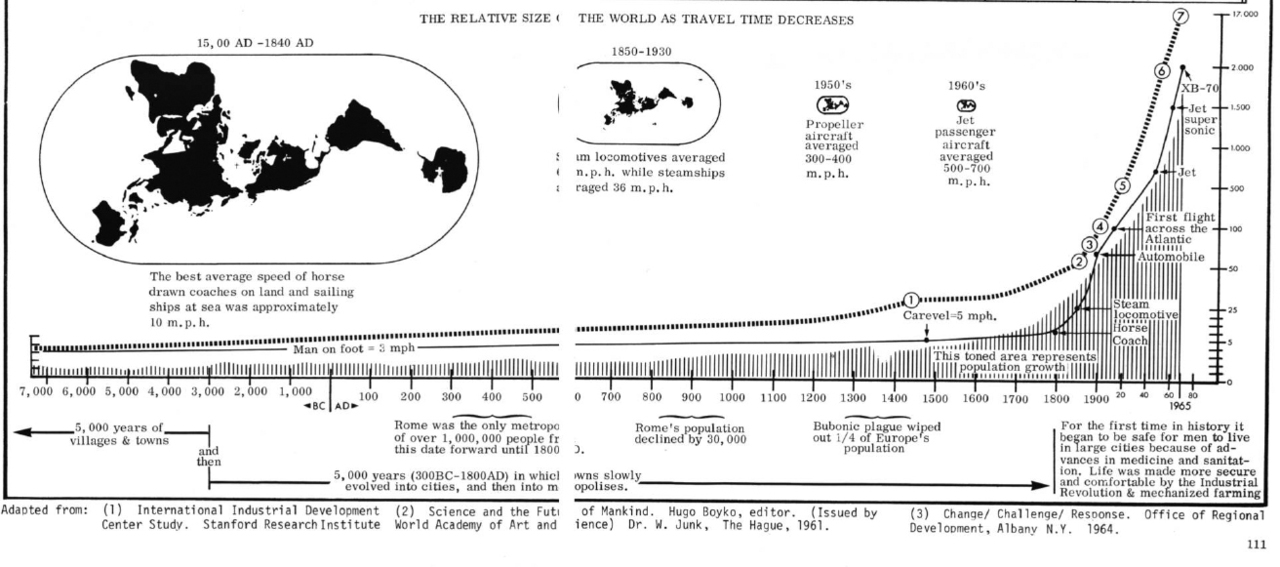
Like all visionaries, Fuller thought in long spans of time, and he used his design skills to help others do so as well. His population visualization documents human growth from 1000 B.C.E. to Fuller’s present, at the time, of 1965. In the image above (see a larger version here), we have a graphic from that same year—made collaboratively with artist and sociologist John McHale—showing the “shrinking of our planet by man’s increased travel and communication speeds around the globe.” (It must be near microscopic by now.) Fuller takes an even longer view, looking at “the confluence of communication and transportation technologies,” writes Rikke Schmidt Kjærgaard, “from 500,000 B.C.E. to 1965.”
Here Fuller combines his population data with the technological breakthroughs of modernity. Though he’s thought of in some quarters as a genius and in some as a kook, Fuller demonstrated his tremendous foresight in seemingly innumerable ways. But it was in the realm of design that he excelled in communicating what he saw. “Pioneers of data visualization,” Fuller and McHale were two of “the first to chart long-term trends of industrialization and globalization.” Instead of becoming alarmed and fearful of what the trends showed, Fuller got to work designing for the future, fully aware, writes the Fuller Institute, that “the planet is a system, and a resilient one.”
Fuller thought like a radically inventive engineer, but he spoke and wrote like a peacenik prophet, writing that a system of narrow specializations ensures that skill sets “are not comprehended comprehensively… or they are realized only in negative ways, in new weaponry or the industrial support only of war faring.” We’ve seen this vision of society played out to a frightening extent. Fuller saw a way out, one in which everyone on the planet can live in comfort and security without consuming (then not renewing) the Earth’s resources. How can this be done? You’ll have to read Fuller’s work to find out. Meanwhile, as his visualizations suggest, it’s best for us to take the long view—and give up on short-term rewards and profits—in our assessments of the state of Spaceship Earth.
Note: An earlier version of this post appeared on our site in 2017.
Built during the depths of the Great Depression (from 1933 to 1937), the Golden Gate Bridge became the longest and tallest suspension bridge in the world. During its construction, workers battled harsh conditions — strong winds, thick fog, and the risk of plunging into the San Francisco Bay. 11 souls perished. Likewise, the engineer Joseph Strauss had to work through complicated design challenges to anchor the structure in the deep waters, then spin massive cables and tension them across the 4,000-foot span. Created by the YouTube channel Animagraffs, the 3D animated video above takes viewers on a technical tour of the Golden Gate Bridge’s construction, deconstructing the engineering that makes the bridge both beautiful and enduring.
Note: If you visit this post in our archive, you can see vintage footage that shows the bridge under construction and then opening to traffic in 1937.
If you would like to support the mission of Open Culture, consider making a donation to our site. It’s hard to rely 100% on ads, and your contributions will help us continue providing the best free cultural and educational materials to learners everywhere. You can contribute through PayPal, Patreon, and Venmo (@openculture). Thanks!
It doesn’t take too long a look at the almost surrealistically clean-lined buildings of Walter Gropius to get the impression that the man wanted to usher in a new world, especially when you consider that many of them went up before World War II. Take the Bauhaus Dessau building, which, though completed exactly a century ago, looks like a concrete transmission from the future that never arrived, or one that may indeed still be on the way. It once housed the German art school turned political and cultural engine he founded in 1919, whose principles included absolute equality between male and female participants — or they did at first, at any rate.
Soon deciding that the new institution wouldn’t be taken seriously with too high a proportion of women, Gropius limited their enrollment to one-third of the student body. That episode, among others that underscore the ways in which Gropius and the Bauhaus’ ostensible commitment to the advancement of women wasn’t all it could be, figures into Susanne Radelhof’s documentary The Untold Story of Bauhaus Women.
Yet whatever the shortcomings in that department one might identify from a twenty-first century vantage, the fact remains that the Bauhaus made possible — or at least encouraged — more enduring and influential work by female artists and designers than almost any art school in early twentieth-century Europe.
Among the almost 500 women who studied at the Bauhaus, the film profiles figures like Alma Buscher, “who created prototypes of avant-garde furniture and toys”; “visionary metalsmith and designer” Marianne Brandt; Gunta Stölzl, whose “weaving revolutionized modern textile design” (weaving eventually being the main program to which women were admitted); Friedl Dicker, a “multitalented artist” dedicated to the Bauhaus; and Lucia Moholy, whose “exceptional photographs still influence how we view Bauhaus design today.” The school itself may have shut down in 1933, owing to the conflict between its aesthetic and political ends and those of the rising Nazi Party, but the forward-looking nature and worldwide cultural influence of the Bauhaus have ensured that we still feel the influence of its alumni, male and female alike.
Based in Seoul, Colin Marshall writes and broadcasts on cities, language, and culture. He’s the author of the newsletterBooks on Cities as well as the books 한국 요약 금지 (No Summarizing Korea) and Korean Newtro.Follow him on the social network formerly known as Twitter at @colinmarshall.
Khipus, the portable information archives created by the Inca, may stir up memories of 1970s macrame with their long strands of intricately knotted, earth-toned fibers, but their function more closely resembled that of a densely plotted computerized spreadsheet.
As Cecilia Pardo-Grau, lead curator of the British Museum’s current exhibitionPeru: a journey in time explains in the above Curators Corner episode, khipus were used to keep track of everything from inventories and censuses to historical narratives, using a system that assigned meaning to the type and position of knot, spaces between knots, cord length, fiber color, etc.
Much of the information preserved within khipus has yet to be deciphered by modern scholars, though the Open Khipu Repository — computational anthropologist Jon Clindaniel’s open-source database — makes it possible to compare the patterns of hundreds of khipus residing in museum and university collections.
Even in the Incan Empire, few were equipped to make sense of a khipu. This task fell to quipucamayocs, highborn administrative officials trained since childhood in the creation and interpretation of these organic spreadsheets.
Fleet messengers known as chaskis transported khipus on foot between administrative centers, creating an information superhighway that predates the Internet by some five centuries. Khipus’ sturdy organic cotton or native camelid fibers were well suited to withstanding both the rigors of time and the road.
A 500-year-old composite khipu that found its way to the British Museum organics conservator Nicole Rode prior to the exhibition was intact, but severely tangled, with a brittleness that betrayed its age. Below, she describes falling under the khipu’s spell, during the painstaking process of restoring it to a condition whereby researchers could attempt to glean some of its secrets.
Visit Museo Chileno de Arte Precolombino’s website to learn more about khipu in a series of fascinating short articles that accompanied their groundbreaking 2003 exhibit QUIPU: counting with knots in the Inka Empire.
Note: An earlier version of this post appeared on our site in 2022.
It was long ago that polytheism, as the story comes down to us, gave way to monotheism. Humanity used to have many gods, and now almost every religious believer acknowledges just one — though which god, exactly, does vary. Some popular theories of “big history” hold that, as the scale of a society grows larger, the number of deities proposed by its faiths gets smaller. In that scheme, it makes sense that the growing Roman Empire would eventually adopt Christianity, and also that the gods it first inherited from the city-states of ancient Greece would be so numerous. Through our modern eyes, the various immortals invoked so readily by the Greeks look less like holy figures than a cast of characters in a long-running television drama.
Or maybe it would have to be a soap opera, given that most of them belong to one big, often troubled clan. Hence the structure of UsefulCharts’ Greek Mythology Family Tree, explained in the video above. Also available for purchase in poster form, it clearly diagrams the relationships between everyone in the Greek pantheon, from the highest “primordial gods” like Eros Elder and Gaia down to the children of Zeus and Poseidon.
However powerful they could be — and some were powerful indeed — none of these gods acted like the infallible, omniscient entities of the major religions we know today. They could act capriciously, vengefully and even nonsensically, a reflection of the often capricious‑, vengeful‑, and nonsensical-seeming nature of life in the ancient world.
For the Greeks themselves, these mythical gods and monsters offered not just an explanatory mechanism, but also a form of entertainment, given that nothing could go on in their elevated world without high drama. For us, they remain present in legends from which we still draw inspiration for our own larger-than-life stories of heroism and villainy, but also in our very language. Consider the ways in which we continue to evoke the likes of the time-ruling Chronos, the love-bringing Cupid, the androgynous Hermaphroditus, or the multi-headed Hydra in everyday speech. Though we may no longer need them to organize our societies, some of them have kept playing roles in the age of monotheism — which, whatever its other advantages, doesn’t require us to consult diagrams to know who’s who.
Based in Seoul, Colin Marshall writes and broadcasts on cities, language, and culture. He’s the author of the newsletterBooks on Cities as well as the books 한국 요약 금지 (No Summarizing Korea) and Korean Newtro.Follow him on the social network formerly known as Twitter at @colinmarshall.
In the video above, UsefulCharts creator Matt Baker suggests that we not refer to the period spanning the fifth and the late fifteenth centuries as the “dark ages.” In justification, he doesn’t put forth the argument, now fairly common, that the time in question was actually full of subtle innovation occluded by modern prejudice. The real problem, as he sees it, is that the slowing, if not reversing, of the progress of human society that we’ve traditionally regarded as occurring in what are commonly known as the Middle Ages only occurred in Europe. What’s more, there have been multiple such eras in the world: take the earlier “Greek dark ages” associated with the Bronze Age civilizational collapse of 1177 BC.
All this and more comes across at a glance on Baker’s Timeline of World History, whose design is explained in the video. With characteristic UsefulCharts clarity (also demonstrated by the World Religions Family Tree and the Evolution of the Alphabet, previously featured here on Open Culture), it lays out all the periods of history we may know better by their names than by their relationship to actual events.
At the top, it begins with the end of prehistory and the start of history: that is, when writing developed around 5,300 years ago. At that point, multiple civilizations had already begun to establish themselves around the world, and it is their growth and decline represented by the thickness of the lines running down the timeline’s regular century-long divisions.
As the early Bronze Age gives way to the Bronze Age, the Bronze Age gives way to the Iron Age, and the Iron Age gives way to Classical Antiquity, these lines of civilization thicken into those of empire. None come thicker than that of ancient Rome, which occupies the visual center of the poster (itself, incidentally, available for purchase from UsefulCharts’ site), but the design’s strength lies less in underscoring the importance of any one empire than of revealing how much history was going on all over the world at any given time. Using its vertical lines to trace the rise and fall of the Olmecs, say, or the Aksumite Empire or the Mississippian Culture, one can hardly suppress a feeling of Ozymandian transience. Nor, for that matter, can one ignore that all of us live out our lives within the span of two of its horizontal ones.
Based in Seoul, Colin Marshall writes and broadcasts on cities, language, and culture. His projects include the Substack newsletterBooks on Cities and the book The Stateless City: a Walk through 21st-Century Los Angeles. Follow him on the social network formerly known as Twitter at @colinmarshall.
We're hoping to rely on loyal readers, rather than erratic ads. Please click the Donate button and support Open Culture. You can use Paypal, Venmo, Patreon, even Crypto! We thank you!
Open Culture scours the web for the best educational media. We find the free courses and audio books you need, the language lessons & educational videos you want, and plenty of enlightenment in between.