We’ve previously featured a series of remarkable little films of French artists Pierre-Auguste Renoir, Claude Monet and Edgar Degas. Here we wrap things up with just one more: a rare glimpse of the great sculptor Auguste Rodin.
The footage was taken in 1915, two years before Rodin’s death. There are several sequences. The first shows the artist at the columned entrance to an unidentified structure, followed by a brief shot of him posing in a garden somewhere. The rest of the film, beginning at the 53-second mark, was clearly shot at the palatial, but dilapidated, Hôtel Biron, which Rodin was using as a studio and second home.
The mansion was built as a private residence in the early 18th century, and served as a Catholic school for girls from 1820 until about 1904, when it became illegal for public money to be used for religious education. When the last of the nuns cleared out, the rooms of the Hôtel Biron were rented out to a diverse group of people that included some notable artists: Jean Cocteau, Isadora Duncan, Henri Matisse and Rainer Maria Rilke, who served for a time as Rodin’s secretary. It was Rilke’s wife, the sculptor Clara Westhoff Rilke, who first told Rodin about the place in 1909.
Rodin first rented four rooms on the main floor, but was alarmed when he learned of plans to sell the property off in pieces to developers. So he made a deal with the government: In exchange for bequeathing all his works to the French state, the sculptor was allowed to occupy the mansion for the rest of his life, and after he died, the estate would become the Musée Rodin.
By the time actor Sacha Guitry and his cameraman arrived to film this scene from Ceux de Chez Nous, or “Those of Our Land,” Rodin was the sole occupant of the Hôtel Biron. The film shows the 74-year-old artist walking down the weed-covered steps of the mansion and working inside, chipping away at a marble statue with a hammer and chisel. When Rodin was asked once about how he created his statues, he said, “I choose a block of marble and chop off whatever I don’t need.”
Note: An earlier version of this post appeared on our site in 2012.
If you would like to support the mission of Open Culture, consider making a donation to our site. It’s hard to rely 100% on ads, and your contributions will help us continue providing the best free cultural and educational materials to learners everywhere. You can contribute through PayPal, Patreon, and Venmo (@openculture). Thanks!
If you had to pick a single figure to represent the concept of the film auteur, you could do much worse than Stanley Kubrick. That’s not to call him the greatest director who ever lived, nor even to call his body of work the greatest in cinema. But no filmography more clearly bears the stamp of a single presiding intelligence across various eras, genres, and styles. On one level, Kubrick never made the same movie twice. On another, each is but a facet of the larger project of rendering on film his ever more aesthetically immaculate, ever less comforting worldview, one that encompasses both Dr. Strangelove and The Shining, both Lolita and 2001: A Space Odyssey.
For that and other reasons, Kubrick’s filmography has long occupied a peculiar position in cinema culture. Despite having provided generations of moviegoers their introduction to the “art house,” it also repays the most serious degrees of engagement and scrutiny. Somehow, as Lewis Bond puts it in the recorded Twitch stream above, Kubrick has remained both cinema’s gateway drug and its “final boss.”
You may know Bond’s name — or more likely, recognize his voice — from the many film-related video essays of his (under the banners of Channel Criswell, The Cinema Cartography, and now The House of Tabula) we’ve previously featured here on Open Culture, including an exegesis of Kubrick he made nearly a decade ago. It says something that even someone as auteur-obsessed for as long as he’s been can’t resist another trip to the well.
Over the two-hour course of his stream, Bond discusses each and every one of Kubrick’s films while ranking them against each other. It will hardly provoke much controversy that he starts at the bottom with the ramshackle thriller Fear and Desire, the debut feature that even Kubrick himself attempted to strike from the record. What really gets cinephiles talking are the relative merits of the pictures higher up the list: Does The Shining transcend horror, or Dr. Strangelove transcend comedy? Is the sensationalism of A Clockwork Orange or the stateliness of Barry Lyndon to be counted for or against those films? Is Eyes Wide Shut a late masterpiece or, as some thought in 1999, a late mess? Bond jokes that his is the objectively correct ranking of Kubrick’s filmography, and perhaps it does align with critical consensus on many points. But few film-lovers will be entirely free of the temptation to watch through it and judge again for themselves.
Based in Seoul, Colin Marshall writes and broadcasts on cities, language, and culture. He’s the author of the newsletterBooks on Cities as well as the books 한국 요약 금지 (No Summarizing Korea) and Korean Newtro.Follow him on the social network formerly known as Twitter at @colinmarshall.
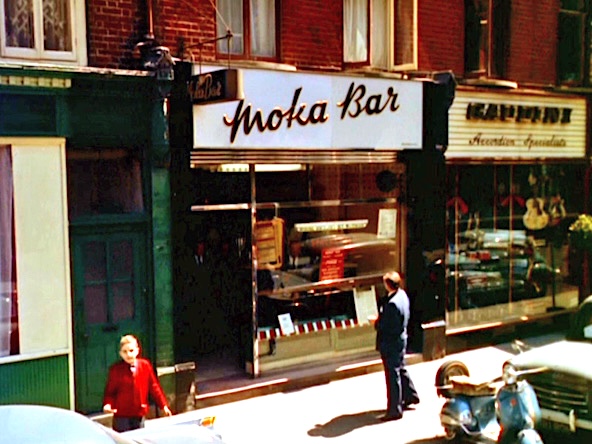
As we’ve noted before, the English coffeehouse has served as a staging ground for radical, sometimes revolutionary social change. Certainly this was the case during the Enlightenment, as it was with the salons in France. And yet, by the early 20th century it seems, coffee shops in London had grown scarcer and more humdrum. That is until 1953 when the Moka Bar, the UK’s first Italian espresso bar, opened in Soho. On his blog The Great Wen, Peter Watts describes its arrival as “a momentous event”:
London’s first proper coffee shop—one equipped with a Gaggia coffee machine—opened at 29 Frith Street. This was a place where teenagers too young for pubs could come and gather, and it is said by some that the introduction of this coffee bar prompted the youth culture explosion that soon changed social life in Britain forever.
“By 1972,” Watts writes, “coffee bars were everywhere and the teenage revolution was firmly established.” Places like the Moka Bar might seem like the ideal place for countercultural maven William S. Burroughs—a London resident from the late sixties to early seventies—to hobnob with young dissidents and outsiders. Burroughs, who so approvingly refers to the possibly apocryphal anarchist pirate colony of Libertatia in his Cities of the Red Night, would, one might think, appreciate the budding anarchism of British youth culture, which would flower into punk soon enough.
But rather than joining the coffee bar scene, the cantankerous Burroughs had taken to frequenting “plush gentlemen’s shops of the area, not to mention the ‘Dilly Boys,’ young male prostitutes who hustled for clients outside the Regent Palace Hotel.”
And he had grown increasingly disillusioned with London, fuming, writes Ted Morgan in Burroughs’ biography Literary Outlaw, “at what he was paying for his hole-in-the-wall apartment with a closet for a kitchen” and at the rising price of utilities. “Burroughs,” Morgan tells us, “began to feel that he was in enemy territory.” And he thought the Moka coffee bar should pay the price for his indignities.
There, “on several occasions a snarling counterman had treated him with outrageous and unprovoked discourtesy, and served him poisonous cheesecake that made him sick.” Burroughs “decided to retaliate by putting a curse on the place.” He chose a means of attack that he’d earlier employed against the Church of Scientology, “turning up… every day,” writes Watts, “taking photographs and making sound recordings.” Then he would play them back a day or so later on the street outside the Moka. “The idea,” writes Morgan, “was to place the Moka Bar out of time. You played back a tape that had taken place two days ago and you superimposed it on what was happening now, which pulled them out of their time position.”
Burroughs also connected the method to the Watergate recordings, the Garden of Eden, and the theories of Alfred Korzybski. The trigger for the magical operation was, in his words, “playback.” In a very strange essay called “Feedback from Watergate to the Garden of Eden,” from his collection Electronic Revolution, Burroughs described his operation in detail, a disruption, he wrote, of a “control system.”
Now to apply the 3 tape recorder analogy to this simple operation. Tape recorder 1 is the Moka Bar itself it is in pristine condition. Tape recorder 2 is my recordings of the Moka Bar vicinity. These recordings are access. Tape recorder 2 in the Garden of Eden was Eve made from Adam. So a recording made from the Moka Bar is a piece of the Moka Bar. The recording once made, this piece becomes autonomous and out of their control. Tape recorder 3 is playback. Adam experiences shame when his discgraceful behavior is played back to him by tape recorder 3 which is God. By playing back my recordings to the Moka Bar when I want and with any changes I wish to make in the recordings, I become God for this local. I effect them. They cannot affect me.
The theory made perfect sense to Burroughs, who believed in a Magical Universe ruled by occult forces and who experimented heavily with Scientology, Crowley-an Magick, and the orgone energy of Wilhelm Reich. The attack on the Moka worked, or at least Burroughs believed it did. “They are seething in there,” he wrote, “I have them and they know it.” On October 30th, 1972 the establishment closed its doors—perhaps a consequence of those rising rents that so irked the Beat writer—and the location became the Queens Snack Bar.
The audio-visual cut-up technique Burroughs used in his attack against the Moka Bar was a method derived by Burroughs and Brion Gysin from their experiments with written “cut-ups,” and Burroughs applied it to film as well. At the top of the post, see an interpretive “meditation” based on Burroughs’ use of audio/visual “magical weapons” and incorporating his recordings. On YouTube, you can watch “The Cut Ups,” a short film Burroughs himself made in 1966 with cinematographer Antony Balch, a disorienting illustration of the cut up technique.
Not limited to attacking annoying London coffeehouse owners, Burroughs’ supposedly magical interventions in reality were in fact the fullest expression of his creativity. As Ted Morgan writes, “the single most important thing about Burroughs was his belief in the magical universe. The same impulse that led him to put out curses was, as he saw it, the source of his writing.” Read much more about Burroughs’ theory and practice in Matthew Levi Stevens’ essay “The Magical Universe of William S. Burroughs,” and hear the author himself discourse on the paranormal, tape cut-ups, and much more in the lecture below from a writing class he gave in June, 1986.
Note: An earlier version of this post appeared on our site in 2014.
In the nineteen-nineties, Quentin Tarantino and Robert Rodriguez first collaborated on a movie. No, it wasn’t From Dusk Till Dawn, the Rodriguez-directed crime-picture-turned-horror-comedy in which Tarantino plays George Clooney’s psychotic brother. It was an anthology picture called Four Rooms, whose separate but interconnected stories, all set in the same hotel on New Year’s Eve, were directed by an all-star lineup of the “Indiewood” auteurs of 1995: Tarantino, Rodriguez, Allison Anders, and Alexandre Rockwell. Rodriguez jumped at the chance to do short-form work and collaborate with friends, but alas, the concept inspired much more enthusiasm from moviegoers than the result, to say nothing of the critics’ judgment.
“Anthologies never work,” Rodriguez said last year during an interview with Lex Fridman. Even with the best filmmakers participating, “they bomb because people can’t quite wrap their head around it”: they feel like the movie keeps starting over and over again. Yet in the fullness of time, Four Rooms took his career up a level, not down.
“I really want this anthology thing to work,” he says, explaining his mindset about a decade after that film’s failure. “What if it’s three stories, like a three-act structure, not four, same director, not four different directors?” After all, “I had already done one and figured out how I could do it better.” The result was Sin City, from 2005, his adaptation of Frank Miller’s acclaimed noir comic-book series co-directed with Miller himself.
By now, comic-book movies, or at least movies that make use of intellectual property drawn from comic books, have long been commonplace. What Rodriguez and Miller made two decades ago was something different: a film that looked and felt just like its source material. As Danny Boyd explains in the CinemaStix video at the top of the post, Sin City was “not an adaptation, but a translation,” which Rodriguez thought of less as bringing the page to the screen than “taking cinema and turning it into a book.” Ironically, Miller had meant to avoid the whole Hollywood development process by deliberately making the original comics as un-filmable as possible — he just hadn’t reckoned on what technology and Rodriguez’s D.I.Y. ethos would eventually make possible.
Having famously broken into Hollywood with his debut feature El Mariachi, the “$7,000 movie” on which he performed all technical duties, Rodriguez understood how digital filmmaking could empower individual creators. The green screen, which enables the placement of real actors into any setting imaginable, promised him a way to re-create the “layers of unreality” that constitute a flamboyantly stylized work of ultra-noir like Sin City. In the video just above, Boyd shows us how green-screen shooting made it possible to realize the comic’s elaborate aesthetic in motion, creating not a cheap substitute for real sets and locations, as has since become dispiritingly common in Hollywood, but another reality altogether. And if you can bring Quentin Tarantino in to guest-direct a sequence, as Rodriguez did, so much the better.
Based in Seoul, Colin Marshall writes and broadcasts on cities, language, and culture. He’s the author of the newsletterBooks on Cities as well as the books 한국 요약 금지 (No Summarizing Korea) and Korean Newtro.Follow him on the social network formerly known as Twitter at @colinmarshall.
Even if you don’t know the myth by name, you know the story. In Greek mythology, Sisyphus, King of Corinth, was punished “for his self-aggrandizing craftiness and deceitfulness by being forced to roll an immense boulder up a hill, only to watch it roll back down, repeating this action for eternity.” In modern times, this story inspired Albert Camus to write “The Myth of Sisyphus,” an essay where he famously introduced his concept of the “absurd” and identified Sisyphus as the absurd hero. And it provided the creative material for a breathtakingly good animation created by Marcell Jankovics in 1974. The film, notes the annotation that accompanies the animation on YouTube, is “presented in a single, unbroken shot, consisting of a dynamic line drawing of Sisyphus, the stone, and the mountainside.” Fittingly, Jankovics’ little masterpiece was nominated for the Best Animated Short Film at the 48th Academy Awards.
Note: An earlier version of this post appeared on our site in 2015.
If you would like to support the mission of Open Culture, consider making a donation to our site. It’s hard to rely 100% on ads, and your contributions will help us continue providing the best free cultural and educational materials to learners everywhere. You can contribute through PayPal, Patreon, and Venmo (@openculture). Thanks!
Even for Americans, keeping up with the geopolitical entanglements of the United States has never been an easy task. More than a century ago, just a few months after their country got involved in what’s now known as World War I, they got word that the military of a distant nation had joined their side: China, whose image would have been both opaque and forbiddingly vast. A dozen years before they’d even heard the name Pearl S. Buck, what impressions of that country they had would have come from scattered sources like post-Opium Wars missionary publications, newspaper coverage of complicated events like the Boxer Rebellion and the fall of the Qing dynasty, and silent-film genre stereotypes. (Perhaps the rare reader got ahold of John Thomson’s Through China with a Camera.) Most could live a lifetime without a glimpse of “the real China.”
By the end of 1917, however, “there were at least 10 documentaries available to satisfy curiosity about America’s new ally in the Far East,” according to the National Film Preservation Foundation. Most were shorts that played alongside features, but A Trip Through China was different. At least five years in the making, “the documentary was the brainchild of Benjamin Brodsky, a widely traveled Russian-born businessman who claimed to speak 11 languages. According to a 1912 Moving Picture World profile, the young entrepreneur had moved to China from San Francisco after the 1906 Earthquake and set up shop as a film exhibitor. Soon, as the American representative of Variety Film Exchange, he had a hand in distribution and by 1909 branched into film production in Shanghai and Hong Kong. While juggling business interests, he filmed his travels,” all of which took place not just before China’s economic rise, but before even the Communist Revolution.
Brodsky brought 20,000 feet of negatives with him back to San Francisco, eventually cutting it down to ten reels, which would have run around one hour and 50 minutes. Of this feature-length travelogue film only certain sections survive, but you can see them enhanced and colorized with artificial intelligence in the video at the top of the post. (Some of an un-enhanced black-and-white print appears just above.) Bear in mind that colors you see are not, of course, the colors Brodsky would have seen; there’s also some discussion about whether the AI rendered certain complexions unrealistically dark for the regions in which he shot these scenes. For China is quite a diverse place, not just in regional landscapes, climates, and cultures, but also in the faces of its people: something many Westerners wouldn’t have guessed in the nineteen-tens — and for that matter, something a fair few of them don’t realize even today.
Based in Seoul, Colin Marshall writes and broadcasts on cities, language, and culture. He’s the author of the newsletterBooks on Cities as well as the books 한국 요약 금지 (No Summarizing Korea) and Korean Newtro.Follow him on the social network formerly known as Twitter at @colinmarshall.
When television mogul Ted Turner died earlier this month, it gave cinephiles occasion to remember his brief but high-profile foray into colorization. In the mid-nineteen-eighties, he commissioned for broadcast colorized versions of more than 100 classic movies, from The Treasure of the Sierra Madre to It’s a Wonderful Life to Casablanca. It was only thanks to a clause specifying a black-and-white picture in Orson Welles’ contract with RKO that Citizen Kane never got the full Turner treatment. That blessedly failed project is now being invoked again in comparison with the startup Fable Studio’s enterprise, underway even now, of using artificial intelligence to restore Welles’ sophomore feature The Magnificent Ambersons, which was notoriously mutilated by the studio before its release in 1942.
The recut happened in Welles’ absence. After the attack on Pearl Harbor, he received what sounds like something more than a request from Nelson Rockefeller, then the government’s Coordinator of Inter-American Affairs, to go to Brazil and shoot a documentary about Carnival in the interest of “Pan-American unity.” Due to a disastrous test screening, as Welles explains in the clip from a 1982 Arena broadcast above, “it was thought by everyone in Hollywood, while I was in South America, that it was too ‘downbeat,’ a famous Hollywood word at the time.” Yet the entire film, to his mind, was about the downfall of the titular family, who lose their wealth and prestige as the society they knew slips out from underneath them during the transformations of the early automobile age: not a widely resonant theme, it seems, in mid-twentieth-century America.
“They destroyed Ambersons,” Welles says of the RKO’s recut, “and the picture itself destroyed me.” Yet even the Bowdlerized version has more than a few admirers. Among them is Edward Saatchi, the movie-loving advertising-company scion behind this AI restoration and/or reconstruction project. “His Amazon-backed generative‑A.I. platform, Showrunner, would feed off the data from the extant version of the film to prompt entire new scenes, based on voluminous production materials that survived, including scripts, photographs, and detailed notes,” writes the New Yorker’s Michael Schulman. “For emotional authenticity, Fable would first shoot live actors, then overlay the footage with the digitized voices and likenesses of the long-dead cast members.” The result has the potential to be unsettling on several levels at once.
As Schulman emphasizes, the film’s concern with the human cost of a technological revolution is hardly lost on Saatchi. “With all their speed forward, they may be a step backward in civilization,” says Joseph Cotten’s character, an early automobile investor, in a scene from the studio cut. “It may be that they won’t add to the beauty of the world or the life of men’s souls — I’m not sure. But automobiles have come, and almost all outward things are going to be different because of what they bring.” Even the human mind, he speculates, will be “changed in subtle ways,” a process clearly in effect by the forties. As far as the consequences of AI, we can already see how it’s begun changing the thinking of its early adopters. Saatchi himself displays an ambivalence about the technology, describing it as “potentially the end of human creativity” but also going full-speed-ahead with his unauthorized work on The Magnificent Ambersons — which, at the very least, he’s keeping in black-and-white.
Based in Seoul, Colin Marshall writes and broadcasts on cities, language, and culture. He’s the author of the newsletterBooks on Cities as well as the books 한국 요약 금지 (No Summarizing Korea) and Korean Newtro.Follow him on the social network formerly known as Twitter at @colinmarshall.
Yasujirō Ozu was born in 1903, and made films from the late nineteen-twenties up until his death in 1963. Though not an especially long life, it spanned Japan’s pre- and postwar eras, meaning that in many ways, it ended in a very different country than it began. Not that you’d know it from Ozu’s films, whose distinctive form and style must have changed less through the decades than those of any of his colleagues. For viewers only casually acquainted with his oeuvre, it’s easy to joke that if you’ve seen one of his pictures, you’ve seen them all. But true Ozu enthusiasts, whose numbers have steadily grown all around the world since the filmmaker’s death, understand that each phase of his career offers distinctive pleasures of its own.
In fact, Ozu persisted through sweeping changes in not just world history, but also the history of cinema. His first 34 films were silent, the next fourteen were sound in black-and-white, and his last six were in color. It is to the domestic master’s third act that Tony Zhou and Taylor Ramos have devoted their latest Every Frame a Painting video essay.
As with most filmmakers, it took Ozu a few years to make color his own: in Equinox Flower, from 1958, “some of the scenes are so bright that it looks like an MGM musical,” owing to his studio’s desire to showcase the actress Fujiko Yamamoto. And it’s not just the hues of her kimono that dominate the images: so does the red of Ozu’s signature teapot whenever it finds its way into the frame.
Ozu’s next color film Good Morning makes use of a “much more natural, earth-toned color palette. The images feel more balanced, and there isn’t one visual element that sticks out from all the others.” In his project after that, Floating Weeds (itself a remake of his 1934 silent A Story of Floating Weeds), he worked with the acclaimed cinematographer Kazuo Miyagawa, who’d also collaborated with the likes of Kurosawa and Mizoguchi. Using strong light and shadow, Miyagawa showed how, “by shaping the light, he could change how colors were perceived,” often in different scenes framed in exactly the same way. At this point, anyone doing an Ozu binge-watch will feel that color itself is being adapted to the rigorous objectivity of his work.
“His films are full of repetitions and small variations,” Zhou says. “He will show the same hallway again, and again, and again.” Seemingly minor elements in one scene match visually with elements in others. “As a result, Ozu’s movies rhyme. One shot will mirror another, one person’s behavior will be repeated,” across not just an individual picture, but his whole filmography. Watch through it, and “you’re struck by how similar two people can be, how often one place resembles another, how life itself is cyclical, and Ozu used color as another way to build these patterns.” Though subtly expressed, these themes would certainly have resonated with audiences in a society forced to reinvent itself after losing the Second World War. Whether Ozu suspected that they could draw even more attention from future generations far from Japan is a question not even his diaries, now the subject of a documentary themselves, can answer.
Based in Seoul, Colin Marshall writes and broadcasts on cities, language, and culture. He’s the author of the newsletterBooks on Cities as well as the books 한국 요약 금지 (No Summarizing Korea) and Korean Newtro.Follow him on the social network formerly known as Twitter at @colinmarshall.
We're hoping to rely on loyal readers, rather than erratic ads. Please click the Donate button and support Open Culture. You can use Paypal, Venmo, Patreon, even Crypto! We thank you!
Open Culture scours the web for the best educational media. We find the free courses and audio books you need, the language lessons & educational videos you want, and plenty of enlightenment in between.