When you want to watch a predator you spend a lot of time watching its prey. For tigers in the wild the prey is often deer. For leopards close to towns it is often stray dogs or goats. In the last few years it is possible to watch leopards round the town of Bera in Rajasthan. Part of the reason is that locals associated with tourism have decided to compensate herders for the animals taken by leopards.
In three years I’ve seen tourism boom around the town. When we first visited there were only a few decent places to stay in. Now there are many. There is also an increasing number of driver/guides who are good at spotting and following leopards. This seems to be a win-win for everyone, including the leopards. No one consulted the goats.
Leopard sightings are best either at dawn or sunset. That is because local experts will know the caves where individual animals spend the day sleeping. So one can search around it to see the animal just after it wakes, or just before it leaves for the night’s hunt. But that means you have to wake up well before dawn and drive out. As I sat in the back of an open jeep driving through the tree-lined road, I was fascinated by the sight of our headlights whipping past the trees. I used my phone to take a photo of the tunnel of light through which we passed. The software in the phone merged thousands of individual frames to give me this photo with a lovely motion blur. That’s intentional camera movement for you.
Our morning was successful. We found a young and restless animal which posed for the camera. My last view of her was when she got up from her perch facing the rising sun and slunk away to her cave. I had my camera set to exposure bracketing, so my last exposure caught three frames in quick succession showing her get up from a sitting posture to a walk. It has been two and a half hours since I’d taken the photo of the road.
We flew back home, and I found that the food had not agreed with me. So my phone and other camera remained untouched for the next couple of days. As a result, these four photos are the last I took in February.
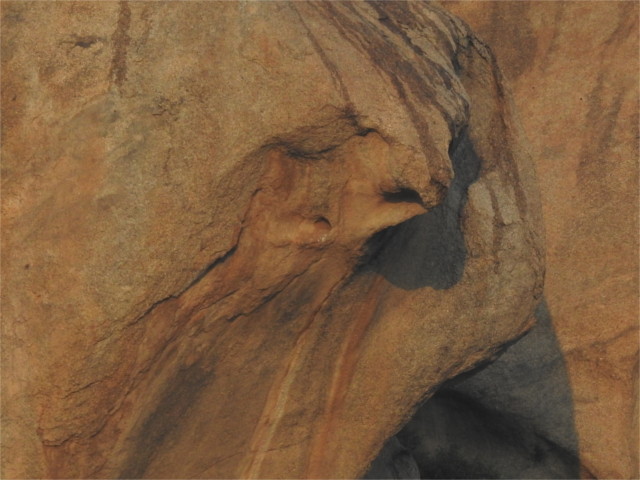
Photography is about light. Even a child with a camera will figure out quickly enough that ill-lit scenes don’t photograph well. And once you figure this out, you can take a lifetime to unlearn this lesson. The outline of this leopard standing in the murky dimness of one of his hides was surprisingly clear in the dawnlight. Unfortunately the cave was so far away that it occupied only a small part of the frame; the rest of the frame was filled with much better lit rocks. I had to play some tricks to get the leopard to register on the sensor. And once I had the image down on my laptop I could develop the photo. But without that soft light this photo would have not worked at all.
It was restless. This was not the cave where it liked to spend the day. It was aware of our jeep, and paced about hoping we would leave. An older animal would have stayed inside the cave and waited us out. A leopard has phenomenal patience. But this sub-adult was like any human teenager, unable to sit still. After a while it came a little way down the rock face. The morning’s light was still very soft. I thought it looked beautiful on the rock and predator. The earliest known leopards were established in Africa two million years ago, and here likely to have been early predators of Hominidae. The Indian leopard (Panthera pardus fusca) is classed as near-threatened, mainly due to loss of habitat and prey base. Bera in Rajasthan, where I took these photos last week, is a successful recent community effort to protect a pool of these animals in the close neighbourhood of humans.
In these volcanic rocks of the Aravali hills, the leopard and its spots are wonderful camouflage. The individual that we had our eyes on moved about and disappeared through a narrow opening between rocks. After a while we realized that it had gone off towards its home cave. As we followed it, our driver-guide spotted it sunning itself under an overhanging rock. But my eyes still took a while to spot it. From my zoom you can think that it is hard to miss, but it was just a small and irregular splotch of white in the wide landscape. The light was beautiful. But within minutes it had melted away. We saw it running again. But then it disappeared into a jumble of rocks which even a jeep cannot negotiate. In this morning light it left behind some wonderful images and great memories for us. We had to leave for the airport now.
Leopards are notoriously hard to spot: they’ll observe you from hiding and duck when they think they can be seen. That’s why I was really fascinated by the relaxed posture of this juvenile, even though I had to take the photo at extreme range. After looking at this in monochrome, I recalled that most ungulates have dichromatic vision, with no ability to distinguish red from green. Now I wonder whether leopards are easier for us to see than their usual herbivorous prey. Since monkey vision is similar to ours, they spot leopards rather quickly. The difference in vision may be a reason why alarm calls of deer are less reliable than those of monkeys.
Kans grass (Saccharum spontaneum) flowers in autumn
How many farmers does the world have? There are around 570 million farms, most of them small ones maintained by one household. I guess that means more than a billion people around the world are farmers. How many soldiers does the world have? A little search told me that there are around 27 million people in armed forces around the world. But the number of games featuring battles and wars is overwhelmingly larger than the number of games that involve farming.
Hog deer (Axis porcinus) in Corbett National Park. They are about 75 centimeters tall.
I tried to find how many pet animals there are in the world. I couldn’t find a definitive answer, but it seems that there are about 470 million dogs and 370 million cats kept as pets around the world. Add in less common pets, and I suppose there are about a billion pet animals to keep us 7 billion odd humans company. The chances are high that each and every one of us either has, or knows a pet animal. I wonder what fraction of humanity has seen any of the threatened mammals of the world in their natural habitat.
Indian elephant baby and mother in Corbett National Park
Some treasures I looked for. But sometimes, when you start typing a query, the Eye of Sauron suggests a different one. I clicked on the suggestion “are video games athletics or not” and came up with interesting nuggets. A clearly biased site, FunTech, offered up the nugget: “professional gamers exhibit high levels of physical strain during competitions” and therefore video games should be considered athletics. I’m sure you’ve realized that the photos have as much to do with the rest of this post as “physical strain” has to do with athletics.
Cloudy sunset over the stony desert in Bera, Rajasthan
Inevitably, using the kind of logical shortcut that video game makers are apt to employ, that brought me to the question of how many treasure hunters there are in the world. The Eye of Sauron could not see a definite answer. The best it could provide was a Wikipedia list of treasure hunters. Someone thinks there are few enough that they can be humanly listed. They probably forgot people like you and me, those who find invaluable treasures.
Tomorrow the day dawns on a new year: 403 ME. The last day of the year, today is an appropriate time to look back and rid yourself of ghosts. If 401 ME was the year we spent in fear, then this past year, 402 ME, was the year that the world burnt. Uncontrolled forest fires blazed through the hills and forests of Uttarakhand, and a wave of the delta variant of SARS-CoV-2 burnt through India. But the year brought its good times too: meetings with family, friends, a slow return to more regular social interactions.
It was the end of an interlude between two waves of the pandemic. We’d spent the early part of the year travelling. I have great memories of two walks during that time. One was the steep trail in Mahabaleshwar which leads from the plateau down to a lovely view of Arthur’s Seat (I don’t know who this Arthur was). The other was the a few kilometers along a historic trade route which once crossed the Himalayas and connected Bengal to Sichuan province in China, through Bhutan and Tibet. The mule you see above is one of the broken line which once facilitated this trickle of trade.
Himalayan Cutia (Cutia nipalensis)
Our long-planned series of trips through the Himalayas, watching birds and following in the footsteps of the 19th century botanists was brought to an abrupt halt. Soon after we were vaccinated, the great wave of delta started. Travel was restricted again, and the trip we had planned to watch the blooming of rhododendrons in Sikkim, and the subsequent push to cross the 5000 meter mark of altitude had to be cancelled.
The end of spring and the following hottest months of year could have been the most depressing months of our lives. The sudden pruning of our circle of friends and acquaintances was drastic. It seemed like a diminished world when we could finally venture out to the Western Ghats in the monsoon. We had missed the flowers of spring in the Himalayas, but we were in time to see the great blooming of the Ghats.
European roller (Coracias garrulus) in the Rann of Kutch
Then, before you could say Sharad Ritu, it seemed that the monsoon was over and the season of migratory birds was on us. Mumbai is at the very edge of a migratory highway, and every season there is great excitement about vagrants having stopped in the city. This year we joined a group of other birders to travel into the center of the passageway, a few hundred kilometers to our northwest, to watch passage migrants crossing India. It was interesting to see exhausted European roller bird (Coracias garrulus) take a halt in their three day long flight from north west Asia to Africa. The chestnut colour on their backs and the blue in front in a complete reversal of the coat of the Indian roller bird (Coracias benghalensis).
The end of the year was a good season for travel. We were fully vaccinated, the pandemic was at a low ebb, and the weather was good. Perfect for a series of visits to nature parks (a special mention of a fantastic sighting of a clan of dholes, Cuon alpinus, the Indian wild dogs) and historic towns we had always wanted to see but never made time for. Now, as the omicron spreads, we are wondering about the best way to ride out the next year.
Silver cockscomb (Celosia argentea) is a common weed. I must have seen it since I was a child, but my first clear memory of it is rather recent. It dates from about two decades ago, when I began to haunt scrublands around Mumbai and in the Sahyadris in search of butterflies. The spiky inflorescences attracted several large and colourful nymphalids, and eventually I began to photograph the flower. In recent months, after the end of the monsoon, I’ve noticed it wherever I go: Mumbai and the Sahyadris of course, but also the edge of the Thar desert, in Bera, and in the central Indian plains, in and around the Tadoba national park. I’ll have to look for it further east in coming years. I’m certain I’ll find it there, because it is considered to be as much of a weed in China as well. It is invasive, having originated in the tropical regions of Africa.
Open patches in the jungle were completely overrun with this flower. I find it quite strange that the widely grown garden plant, the cockscomb, is the same species, usually called Celosia argentea var. cristata. How many generations of selective breeding must have gone into creating those showy flowers! I always found the velvety curls of the garden flower faintly repulsive. I like the clean lines of the original wild stock much more attractive.
I stared at a patch of these flowers while everyone around me wasted their time scanning the jungle for a glimpse of the tiger. I love these tiger safaris; the herd of tourists act as lookouts, and their alarm calls are easy to recognize. I can leave the spotting to them and concentrate on these other aspects of the surroundings. The flower bearing stalks rose perhaps a little above knee high, certainly less than a meter tall, but high enough to make the flowers the first thing that a pollinator would spot from far. The bodies of the plant are visible in the photo above.
Historically in India the plant has been eaten when times are hard, and in parts of India it finds regular use as food. It is used traditionally to treat various ailments, including as an anti-parasitic agent. The literature on isolating medically active molecules from the plant is too large to quote here. Interestingly, there have been recent studies in using the plant to suck up heavy metal pollutants (manganese, cadmium, copper) from contaminated soil. This ability to quickly accumulate poisons should make it less attractive as a vegetable. Perhaps this is the reason its use as food persists only in remote places which may not have seen much industrial pollution of the soil. Not being prone to eating random plants, I’m happy to explore waste ground where I see these flowers.
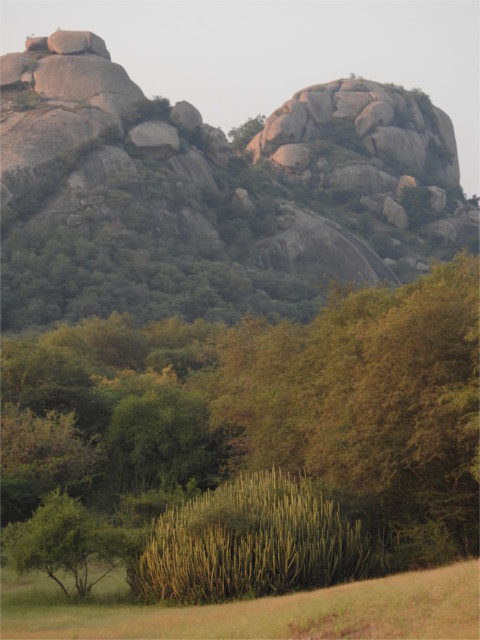
The landscape of Bera. This is what tendua (leopard) country looks like. Old and weathered granite, interspersed with spiny bushes of thor, and lots of babool (Acacia). It’s a beautiful subject for photography.
There are times when the hyper-connected world really bothers me. I know the bird that you see here as the black-shouldered kite. But I must learn to call it a black-winged kite (Elanus caeruleus). There is a different bird called a black-shouldered kite in Australia, and I rant about the jetset bird-watchers across the world for whom we must change the common name for this bird. Would this coincidence mess up their lists all that much?
This is a misplaced rant, though, because the real reason for this distinction is different. The black-shouldered kite was long thought to range down to Australia and across the Atlantic to the Americas. It was only realized recently that the label hid three distinct species: E. caeruleus, which ranges from the Iberian plateau across Africa and India to Sundaland), the Australian E. axillaris, and the new-world species E. leucurus. The change of names is necessary because of a new discovery. Still, I rant because common names need not change by the fiat of a committee. Tracking species is the domain of the Latin binomials, not of the common tongue.
That morning in Bera when we halted the jeep near this docked tree and watched the bird, we were content just to look at what was in front of us. I had a close look at one after months, and I studied its scaly claws. These scales are distinctive to the genus, and not found in the Milvus kites. In fact, Elanus are thought to be the link between owls and kites. Looking at the recessed eyes, and somewhat flat face, I could imagine it. I waited for it to fly, but when it did it pushed itself back, away from us, and turned instantly away. This manoeuvre was so owlish that I hadn’t expected it, and missed the shot of its take off. Another time. They are common, after all.
Once upon a time, the story goes, every part of India was teeming with birds. I’ve heard this story from my grandmother. So it is nice to spend a weekend in a place where this could almost be true. The moment we get out of the village and into the fields around Bera, we began to see birds. There were the passage migrants which we had also seen in the Rann of Kutch, and the utterly familiar endemics.
This was a varied habitat; the edge of the Thar desert, but the dammed river nearby held water. Ibises and herons, wagtails and sandpipers could be seen there. In the thorn bushes we saw francolins, bushchats, and larks, as well as doves, fork-tailed drongos, and bulbuls. The small birds of prey, black-winged kites and shikra, told us of the numerous rodents in the area. Nightjars and owls could be seen at night, flying from the headlights of the jeep. We were told this was early for the winter migrants; they arrive in November.
Bera is known only for its leopards. But it turns out to be a good place for birds too. We did not see anything we hadn’t seen before, but we did spot some passage migrants without really looking for them. I’m sure there is much to discover here.






 Don't hold your breath
