

On Diwali day in Nepal I admired the rangoli that was being created in the hotel. The colours and the style reminded me first of the rangolis I’ve seen in Bihar, due south of the Kathmandu valley. The technique of making an outline before beginning to fill the interior with coloured powders reminded me of the Diwali rangolis from Bihar. But the design seemed different. Paisley dominates the rangoli in eastern UP and Bihar, sometimes stylized into diyas, sometimes fractally elaborated with more complex patterns. But this was something else. Something niggled at the back of my mind, but I couldn’t place it.

Until I got home.
My neighbours are Tamil, and they make a kolam, a Tamil version of rangoli, outside their flat every day. The daily Kolam uses a single colour, usually white, since the tradition was to use powdered rice. The design starts with dots laid out on the ground in a square grid. Lines are drawn either surrounding the dots, or through them. The artist tries to make a symmetric pattern.
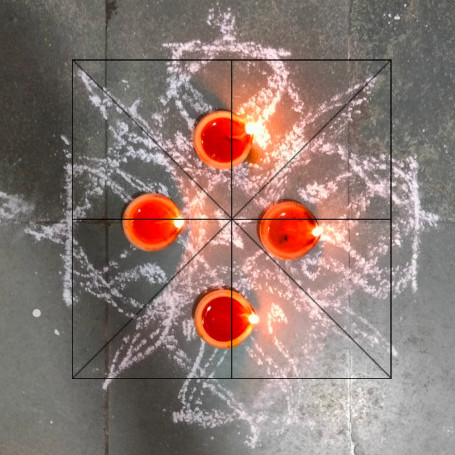

No matter which way it is done, the design inherits the symmetries of the starting grid. I’ve drawn guide lines over the last pattern to show the symmetries which a square grid of dots will give to the pattern. On the left you see the original pattern. The panel on the right shows what this pattern looks like if it is rotated by 90 or 180 degrees (top row), or reflected in a “horizontal” and “vertical” lines (middle row), or reflected in two diagonal lines (bottom row). The diyas don’t have any of these symmetries, so you can use them to see how the original pattern was rotated or reflected through imaginary lines. These were the symmetries of the rangoli which I saw being made in Nepal.
Of the nine Kolam patterns that I showed in the first panel of this post, eight have the symmetries of the square, which I’ve illustrated above. The first one is different. It has symmetries of a hexagon. I’d never seen this before. It would have been made with the starting dots laid out in a triangular grid. I wish I’d seen how it was made.


 Don't hold your breath
