

Microsoft Foundry Blog
Your source for learning and building with our models, agents, and tools.
Featured posts

What’s new in Microsoft Foundry | October 2026

Plan your Microsoft Ignite November 17-20 viewing, then explore October's Copilot harness preview, GA browser automation and hosted-agent resilience, Decisions ...

Introducing the Microsoft Copilot harness in Foundry Agent Service


A model can reason about a task. Completing that task takes more: the right context, tools, execution environment, and controls, and an agent loop that brings t...
Latest posts

Hosted agents in Foundry Agent Service at Ignite 2026: from pilot to production inside your enterprise boundaries


What is new for hosted agents in Foundry Agent Service at Ignite 2026: shared subnet IPs, private CA trust, network egress controls, deployment to your own AKS clusters, resilient execution, memory snapshots and A2A passthrough.

Browser Automation Tool in Microsoft Foundry : Ignite’26 Announcements


Enterprise-ready cloud browsers for every Foundry agent: MCP action batching, Live View and Take control, session recording, VNet injection, browser proxy, profile reuse, secret management, and CAPTCHA handling.
The Foundry Dev Pack is here: build Foundry agents your way

Your next agent can start wherever you like to build: in your editor, at the terminal, or with your favorite coding agent. At Microsoft Ignite, we're making that first step easier: the Foundry Dev Pack (aka.ms/foundrydevpack) is now generally available, bringing the Microsoft Foundry developer tools to your machine in a single install. Move from setup to building, debugging, evaluating, and deploying agents in the environment you already know. The Dev Pack combines the Foundry CLI () and Microsoft Foundry Skill, and installs the Foundry Toolkit for VS Code and Foundry plugin for the GitHub Copilot app wh...

What’s new in Foundry Agent Service at Ignite 2026
Your customers don't judge agents by how well they demo. They judge them by whether the work gets done: the case resolved, the report delivered, the follow-up sent. That takes more than a model. It takes the right context and tools, a runtime that holds up under real demand, and a way to keep improving once real users put agents to work. At Ignite 2026, Foundry Agent Service delivers new capabilities to get you there across the agent lifecycle: Build, Deploy, and Operate. Build more capable agents faster with the managed Microsoft Copilot harness, real-time voice, and richer tool connections. Deploy them at sc...

Build once, reuse across your agent fleet: Tools and Toolboxes in Foundry

Connecting one tool to one agent is not hard. The challenge is managing a useful set of tools and agentic capabilities across a fleet of production agents at scale. Every new agent shouldn't require you to build the same integrations, copy the same instructions, and troubleshoot the same dependencies. And adding a useful capability shouldn't require a separate rollout in every agent application. Toolboxes in Microsoft Foundry turn tools, skills, and agents into shared capabilities. Curate and version them in Foundry, expose them through one MCP endpoint, and reuse them across Foundry agents and other MCP-compa...

Content Understanding adds GPT-6.1, 6, and 5.6: Choose the right model for your workload

Azure Content Understanding now supports the GPT-5.6, GPT-6, and GPT-6.1 model families, giving you more choices for document, text, speech, and video workflows. This adds to the existing set of supported models like the GPT-5 series. To help customers understand how to use this expanded set of options, we're updating our model recommendations and sharing the evaluation data behind them. In our GPT-5 model-selection guide, we described model selection as a mixing board: adjust quality and cost for each workload. The new models add range to those controls. Not every workload needs to be set to maximum, so w...
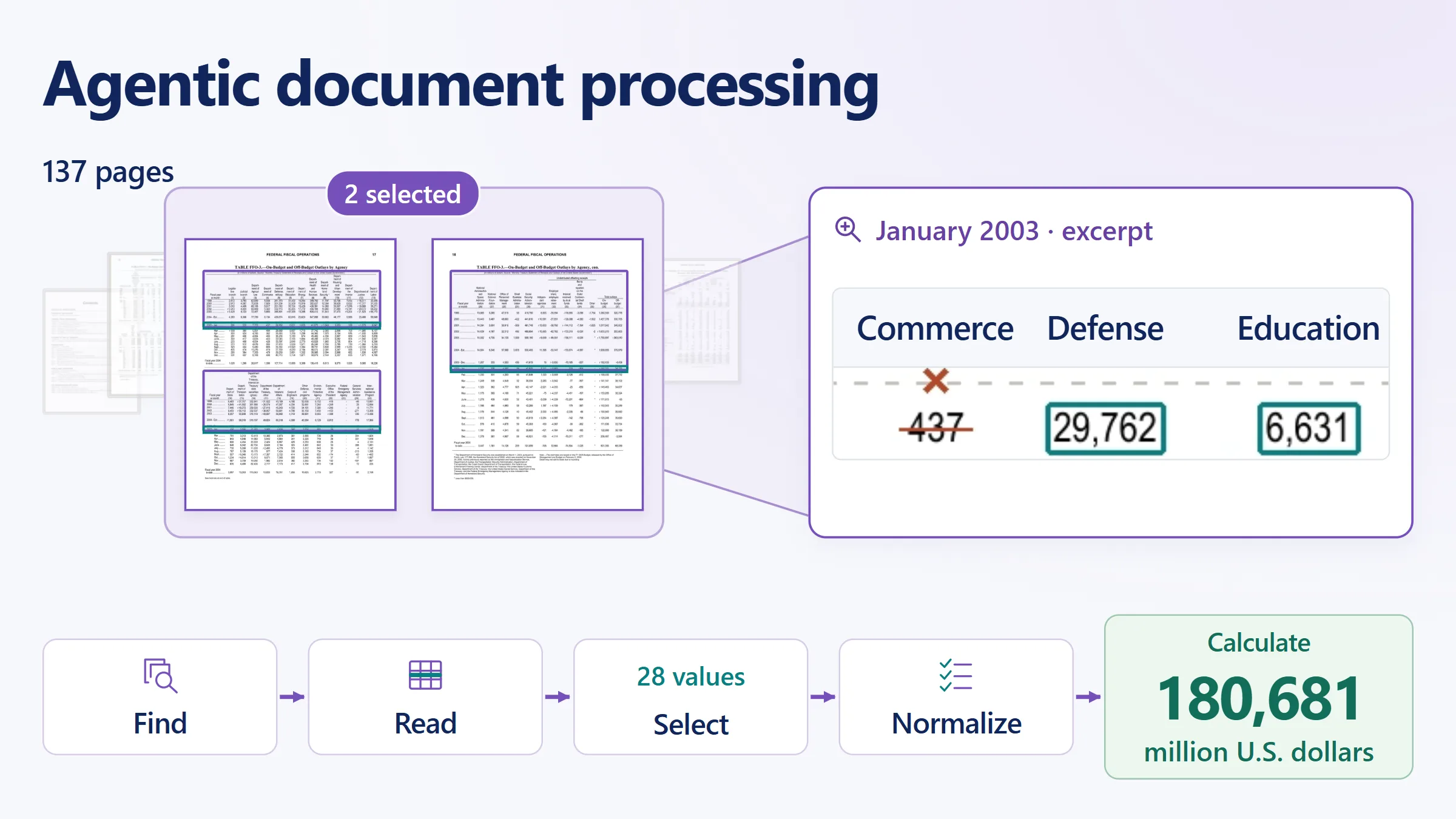
When one pass isn’t enough: agentic mode in Azure Content Understanding
Most document analysis takes one efficient pass. Learn how agentic mode gives AI a document-native harness for the hardest tasks, and when to choose it over standard mode. “Some books are to be tasted, others to be swallowed, and some few to be chewed and digested.” Francis Bacon, “Of Studies”, 1625 A.D. Francis Bacon once observed that an intelligent reader doesn’t consume every book the same way: some are swallowed whole, while a few must be chewed and digested. As we build specialized agents to process documents, we’re learning that lesson again. When we started building Azure Content Understanding in ...
Microsoft Foundry extension for Azure Developer CLI is generally available

Set up, test, evaluate, and deploy hosted agents with the generally available Microsoft Foundry extension for Azure Developer CLI, keeping agent and deployment configuration alongside your code.
Bring Agentic Coding On-Device with Foundry Local


Foundry Local brings agentic coding directly to developer hardware.
