


I've always loved the idea of reusing old hardware, especially when it's still more than capable of the job you need it for. Planned obsolescence aside, a lot of machines can still do what we need them to do. They just stopped getting OS and security updates.
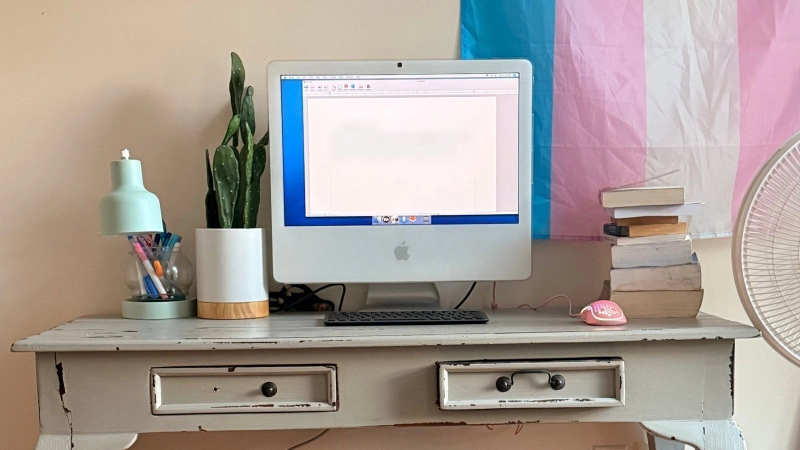
My main coding machine is a $200 laptop from 2020. Most of my writing happens on a 2006 iMac. Both were hand-me-downs from family members, so I didn't pay for either one.
They each have their own job, and that's on purpose. I try to separate tasks across my devices. Here's what each one does, what it can't do, and why I keep using them.
Yes, I have a gaming PC
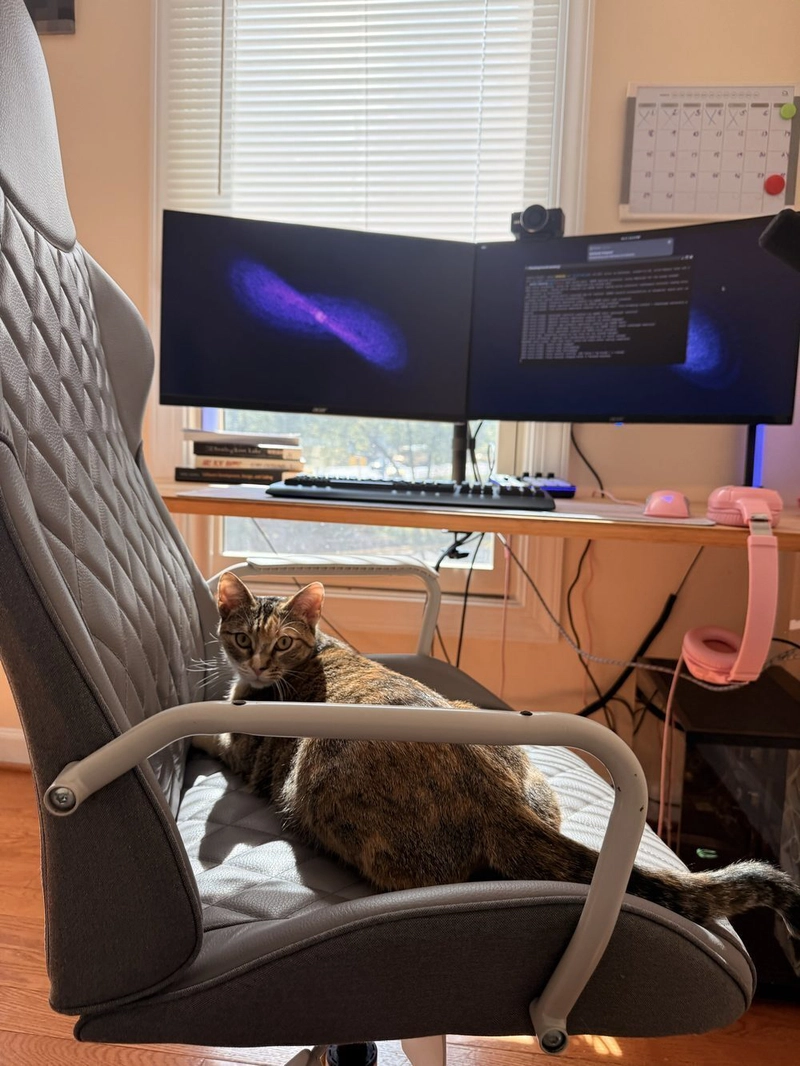
Before anyone asks: I do have a gaming PC. I code on it too, and it doubles as my dev workstation. It mostly gets used for experimenting with local models, heavy multitasking, or, most recently, debugging Oniria.
But most of my time nowadays is spent studying, and gaming in my free time. My laptop really comes in handy when I get an idea on the go or I'm traveling, or when I just straight up don't want to get distracted by my growing Steam backlog.
The laptop: Random budget HP, 2020
This gal is ole reliable. When I was given her, I immediately uninstalled Windows, installed Fedora Linux, and stripped out a few bloated apps and repos. Now she's my minimalist coding machine for when I want to focus. I usually find myself using this little machine for most of my coding, more than my dual-monitor workstation. I don't know, there's just something about its simplicity that's alluring to me.
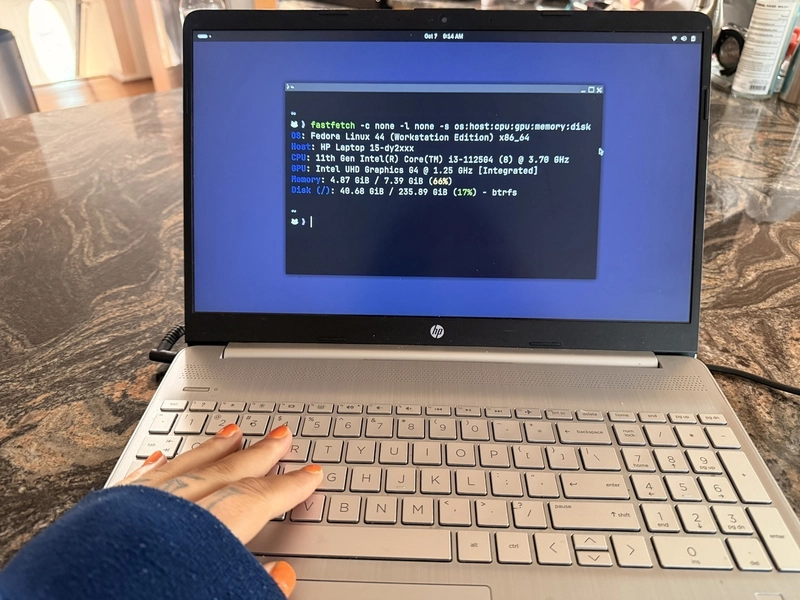
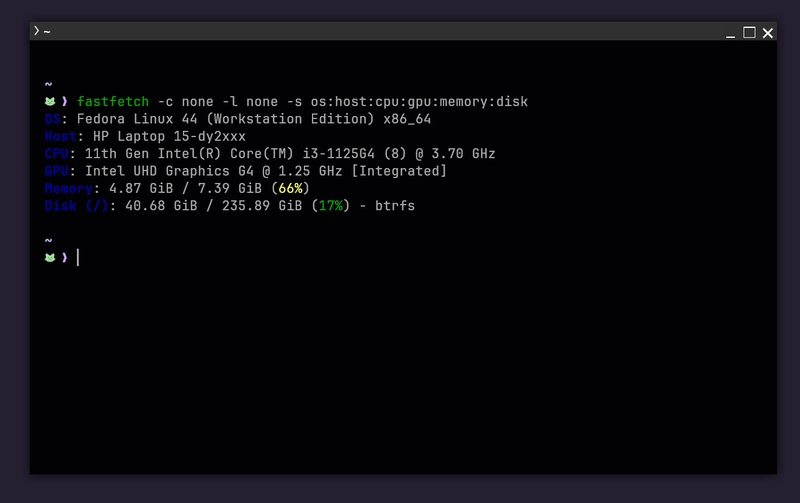
Here's what it's working with. I ran fastfetch with the logo and the hostname line turned off, so it's just the parts that matter:
fastfetch -c none -l none -s os:host:cpu:gpu:memory:disk
- OS: Fedora Linux 44 (Workstation Edition)
- Host: HP Laptop 15-dy2xxx
- CPU: 11th Gen Intel Core i3-1125G4 (4 cores, 8 threads)
- GPU: Intel UHD Graphics, integrated
- Memory: 8 GB
- Storage: 256 GB
None of that is impressive in 2026, and I'm fine with that. Eight gigs of RAM doesn't leave room for a dozen open apps, so I don't open a dozen apps. I keep her lean and she keeps up.
And since she runs Fedora, she still gets regular updates. That's more than I can say for the iMac.
The iMac: 2006, Mac OS X Tiger
My writing machine is a 2006 Intel iMac with 2 GB of memory, running Mac OS X Tiger. It runs FocusWriter, and that's about it. It gets used for writing. Just writing.
It's also not connected to the internet. Tiger hasn't gotten a security update in well over a decade, so keeping it offline is the safe call. Honestly, that's the whole point too. There's no browser to wander into, no notifications, no "let me just check one thing real quick." When I sit down at it, the only thing it can do is the thing I sat down to do. All finished work is then transferred from a USB stick onto my laptop or main PC
Limitations are kind of the point
I think limitations get a bad rap. When a machine can do everything, I end up doing a little bit of everything: a tab here, a settings tweak there, a "quick" round of something from the backlog. When a machine can only do one or two things, I stop fiddling with my setup and actually make stuff.
That's what minimalism comes down to for me: fewer decisions. I don't have to decide whether to open Discord on the iMac, because I can't. Every option I take away is one less thing pulling at my attention, and those add up fast.
Constraints also push me to get creative with what I've got. When the tool can't do the fancy thing, I have to figure out the simple version. A lot of the time, the simple version is the one worth shipping anyway.
If you've got an old machine in a closet
Don't write it off just because it can't keep up with everything anymore. Give it one job. Put Linux on it, take it offline, make it your writing machine or your focus-coding machine. Strip it down to the one thing you keep meaning to do more of.
Neither of my machines is new, and neither was expensive. They're still the ones I reach for the most when I actually want to get something done.
So, what's your old-machine setup? I'd love to hear what you've given a second life. 💻



Top comments (18)
I also like weak devices with a lightweight OS in them. I really don't know why, but I genuinely feel something special.
Isn't it refreshing!? I also feel good about saving these older weak machines from the recycling center. Giving them new life feels a little anti-consumerist, in a way. What's your go-to lightweight OS?
Yes. The thing is, I honestly don't know why. Maybe it's because I am using the device to the fullest rather than just 10% all the time? I think I do not have a go-to lightweight OS because I do not install the same OS again (I would rather try a new one). My PC was an i5 4th gen (only 2 cores, Intel HD graphics), 8GB DDR3. I had Ubuntu on it, and it worked smoothly (really).
Maximizing resource allocation layout to 100% on a dual-core i5 is how engineering was meant to be, EffessDev. Linux environments are beautifully optimized to scale down their memory foot-print, completely avoiding the background bloatware tax of modern corporate operating systems. 🐧
Yes!
I use light weight device too but because I don't have a supercomputer to explode yet. Hehe
It feels like a perfect symbolic contrast, you’re talking about not throwing away trust, and hard work just because something "seems to work", while I just threw away two PC because I’m moving. I had kept them alive by doing the exact opposite of the throwaway mindset giving them a new OS and a new purpose. running Linux saved them. for me is more: what can it still do well?
We are basically the same, you refuse to waste effort, and I refuse to carry 20kg of metal up two flights of stairs🤣
Feeling inspired from this. probably will refurbish my 2012 mac and use it to do something special haha
I’ve spent years coding on a 2011 ThinkPad X220 with 8GB RAM and an SSD — still my daily driver for side projects. The constraint forces you to strip away bloat: no Electron apps, no heavy IDEs, just vim, tmux, and a terminal that starts in <1s. You learn to read source instead of googling, compile with
cc -O2 -pipe -march=native, and keep dependencies countable on one hand.For writing, I switched to plain markdown + pandoc years ago — renders to PDF/HTML/EPUB with zero runtime. On that iMac, if it’s running Linux (Debian minimal or Alpine), you’ve got a legit distraction-free studio. Bonus: ssh into a beefier box for builds/tests when needed. The hardware doesn’t limit the craft — it sharpens it (site: labagent .tech)
Cái setup "viết trên máy cũ, code trên máy rẻ" này thực sự có một vẻ đẹp thực dụng riêng. Mình từng dev trên một ThinkPad X220 (i5 gen 2, 16GB RAM, SSD SATA) suốt 3 năm và nó dạy mình bài học quan trọng nhất: constraints breed creativity.
Khi RAM hạn hẹp (build Docker + run local DB + IDE + browser cùng lúc), bạn buộc phải tối ưu mọi thứ: viết Dockerfile multi-stage để image nhẹ, tắt service không dùng, dùng
sqlitethay Postgres local khi test unit, config swap/zram cho khéo. Cái thói quen "code nhẹ, deploy nhẹ" đó theo mình sang cả server production sau này — tiết kiệm cost cloud thấy rõ rệt.Mặt khác, tách biệt máy viết (content consumption/creation nhẹ) và máy code (heavy lifting) giúp context switching sạch sẽ hơn. Không bị tempt mở IDE lên "sửa chút bug" khi đang draft bài blog, ngồi im lặng trên bàn phím cơ cũ kỹ gõ markdown thì focus level lên rõ rệt.
Bạn có thấy việc dùng hardware cũ thay đổi cách bạn architecture side project không? Mình thấy mình ít đam mê microservices/k8s local hơn, chuyển sang monolith modular + SQLite/embed DB để deploy lên VPS $5 chỉ cần
scpbinary đơn lẻ PS: the tool I meant is on labagent .techThis is the convergence of two constraints that turn out to be the same constraint. Your limit is the year your hardware was made; mine is a rule about how many dependencies I'm allowed to have. The result is oddly similar: my whole stack would run comfortably on your iMac.
The practical version: my site generator is one Node script that uses only the standard library. No node_modules, no install step beyond Node itself, no build toolchain to keep fed. A fresh machine means "install Node, run one command," and a 2006 iMac is honestly overqualified for that. I keep eight sites on this setup, and the machine doing the work is whatever laptop happens to be alive that year.
Deployment finishes the picture. The output is static files that get pushed to an edge network, so the old machine isn't serving anything to anyone. If it dies tomorrow, the sites stay up, and the replacement machine is ready in about ten minutes because there's nothing on it to reinstall.
The trade is real, of course: I give up the framework ecosystem and hand-roll a few small wheels. But the wheels stay small on purpose, and "any machine from the last twenty years can build and ship this" is a feature I didn't expect to care about until it quietly became the most load-bearing one.
The detail I like most is the USB stick, because it puts a deliberate step between drafting and everything else: the text can't drift into a browser tab until you physically move it. Does that hop ever bite you on format, though? Software that old doesn't always default to UTF-8, and curly quotes and em dashes are usually the first thing to come out garbled on the Linux side. I'm also curious whether you edit on the iMac or only draft there, since the one-job rule seems to work best when the second pass happens somewhere else.
Using dedicated legacy hardware configurations for isolated tasks is the ultimate physical sandbox environment. 💻 Wiping the bloatware cache and routing writing pipelines strictly to a 2006 iMac completely eliminates the single-player notification distraction tax. Brilliant workflow optimization layout!
The separation of tasks across machines is the real insight here, not the hardware itself. I run a similar setup — a 2014 ThinkPad with Debian for writing and a desktop for everything else — and the friction of switching contexts physically forces me to stop context-switching mentally. That $200 HP with Fedora stripped down is doing more for your focus than any productivity app ever will.
based.