Dark-Side-of-the-Moon-under-the-sea. A lovely, decidedly darker, rather murky effort compared to what the new listener may be used to: its brooding essence throughout is matched only on "Animals."
This album is, essentially, a musical biography of that thing you felt brush up against your leg when you were in the swamp. "One of These Days," the opener, allows you to view it in its purest form: its sheer menace. It sounds like Hawkwind ate The Silver Apples and spat out the coda of "Good Vibrations" by The Beach Boys. It's disgusting in the absolute best possible way.
We are then taken to the swamp creature's hiding place in "A Pillow of Winds," somewhere straight out of Great Expectations. It's an intimidating white cliff jutting out over the sea during a dark (but not forboding) night of intermittent rain. Somewhere calm, where this entity can live not for its menace, but for its sheer prehistoric wonder. Incredible. I've never seen a fish like it.
The beast is gonna prove you wrong, though. It's not so big and scary. Actually, it's quite a nice animal. Want proof? He'll show you. "Fearless" will make him smile a smug smile and say something along the lines of "You wanna say that again, champ? Hm? Doubtful." This fish is SUCH a cool guy. Wow.
Remember his hiding place? That's not exactly necessarily his happy place. "San Tropez" is, where he can swim in the shallow, clear lagoons of an as-of-yet-undiscovered island that is a tourist-trap waiting to happen. This is one prehistoric swamp fish who takes his horchata in a coconut shell dressed in a Hawaiian shirt and a lei, the whole image captured on a mid-1950's era postcard from somewhere tropical. The whole thing oozes post-war gelatinous suburban dinnertime. It's brilliant.
"Seamus." That's the dog. A delightful track but, honestly, a distraction from the rest of the album.
"Echoes" puts the fish back into focus. We've seen him as a menace, we've seen him be himself, we've seen him be daring, we've seen him be relaxed, and we've met a dog. What we never knew, that "Echoes" reveals, is that there's more than one fish, and that fish may not even be a fish at all. This fish is the life force that swims through Pink Floyd's catalog, each time manifesting itself as a new being. And what's more? Through "Echoes" the fish asks you to join him. And so, you, too, are transformed into an ethereal being. Pink Floyd have immersed you in their art and they never want you to return to what you were doing before.
I sincerely hope this is how you get introduced to Pink Floyd. They're about to take you on a sweet trip.
One of my favorite Pink Floyd albums. I've heard others criticize this album, especially the inclusion of "San Tropez", but I honestly think that this album was produced at a time that predated what producers felt the "Pink Floyd Sound" was all about. I love the looseness... I especially love that San Tropez was included!!!
Russell Newton
January 24, 2016
The high water mark of the Gilmour-era psychedelic period, yet with a much stronger focus while retaining its penchant for moody, atmospheric pieces. This album serves as the bridge between their psychedelic past and their powerhouse future.
It's no coincidence that the band finally turns a corner here. Led by Roger Waters's songwriting but with David Gilmour emerging as the main vocalist, all the pieces were finally in place for their breakthrough. "One of These Days" is a great mostly-instrumental opener, showcasing a tighter, more muscular attack than most of their material since Syd Barrett left. "A Pillow of Winds" is the rare love song in Pink Floyd's repertoire, which references elements of their past, while "Echoes" is their last foray into extended pieces, and they finally nail it here.
"Meddle" was their best album up to this point, and it would serve as the launchpad to send them into the stratosphere in short order.
bill withers
December 29, 2015
The most re-listenable album Pink Floyd have, and that is saying something. Of the six tracks, thankfully, the longest is also the best. Echoes is haunting. If you like Dark Side of the Moon, you will like Meddle.
Javier Pascual Mesa
March 4, 2016
Prog rock at its finest. Lay back, close your eyes and think. Think about whatever lingers by your mind, and Meddle's mellow rhythm will guarantee a rollercoaster of emotions. But then again, you can mimic this with any Pink Floyd album you take. That's how good they are.
I'm startled and astonished to find listeners unable to discern any 'central theme' in 'Meddle' (or 'Atom Heart Mother'). This complaint keeps emerging, why?
I feel it's safe to say that Pink Floyd's theme --constantly featured in most of their works--is anthropomorph-icism. Waters repeatedly uses animalistic metaphors and analogies to carry his ideas. And it's a great theme; make no mistake.
It appears in both large and small ways in album after album throughout their entire career. You can even find Waters on 'Pros/Cons' still doing it ("..I am just a rat in a cage").
Other, album-specific elements (on any given disc) are always featured as well--on 'Meddle' you get a lot of stray influences from vacation trips they may have taken around that time. Okay; and also their early misgivings about the music business, (the spine of 'Wish You Were Here') and the recurring fear of what can happen to 'a man who goes crazy' (Barrett's tragedy, sifted for profundity).
But the issue of 'animal man' or 'primitive man' and his plight within a dense (and often dangerous), modern society with institutions like war, schools, business--is consistently presented. The noble animal & his age-old urges (food, sex, warmth, shelter) is always compared [in Floyd] to vast and terrifying modern economic, social, & political systems.
Not trying to sound like an egghead here --nor snooty--but its all fairly apparent without any effort to detect. 'Welcome-to-the-Machine' on 'Wish'--remember? The capitalism on 'Animals'...the greed & ambition on DSOTM ('Money') arrayed against a simple, primeval disquietude and unease at the change of seasons, the swirling of the stars in the heavens, the futility of all effort. Plus more Barrett loonies.
Anthropomorphicism, easily seen in 'Animals' of course (dogs, pigs, sheep) but here in 'Meddle' you also get the dog theme (mournful barking) on 'Seamus'. Live 'Pigs' (Montreal) has Waters adding impromptu lyrics of a master calling his dog. ['Animals' concerts were much wilder than what went on the LP, sadly].
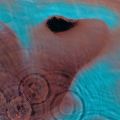
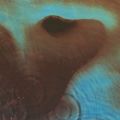
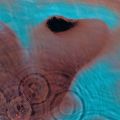
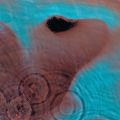
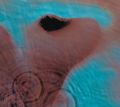
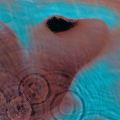
Look then at the giant, cute, dog-head-shaped earlobe on the 'Meddle' cover; and then of course, seagulls & marine life throughout 'Echoes'. Versus coins (more money). In 'Meddle' you get another vivid flash of the 'crazyman' theme 'Axe/Eugene', (inspired by another music-biz scarab), and the-idiot-vs-the-judge in 'Fearless'.
'Atom Heart Mother' *salutes* primitive man. Hear the chorus chanting incantations? Then, 'Alan's Psychedelic Breakfast': barnyard snorting, slobbering. 'Free Four': 20th c. man pondering the bounds of his too-short life. All this, vs 'unfolding petals' & 'wakening owls' in 'Set the Controls' or 'Grantchester Meadows'.
'Modern' consciousness (in Floyd) always confronts a pastoral, bucolic past. Here in 'Meddle' the contrast is vs nature/Caribbean. But the same dichotomy is still there.
Meddle is aptly titled, as the band kept the hazy lazy charm found during More while coming back to the evocative space-rock of their first two albums. But this was not planned.
The band was still relentless touring and at the beginning of the recording sessions begin ’71, they had few ideas and no actual songs at all. Fortunately, their recording contract with EMI included unlimited studio time, so they began to experiment again, the four of them together in the studio.
Our architects began to strategize. They tested blindfold composition (failed), household objects (failed), and finally nailed fragments which they called "Nothing" and numbered from 1 to 30 which they now had to put together to create a kind of building.
And “Echoes” slowly appeared, one of their very best works. Throughout 5 evocative movements, the music smoothly moves from a peaceful and languid mood to spacey funk, to an eerie float in space, to a riveting build and release of tension, then back to the peaceful mood of the beginning. What a trip.
The first side of the LP is uneven, offering super-strong numbers with “One of These Days” and “Fearless” but also fillers in “San Tropez” and “Seamus”, these two tracks preventing Meddle from being a total masterpiece.
Even if Gilmour particularly shines, Meddle is really a collective work where everything is ego-less and necessary to reach a well-defined aim. After the disjointed Atom Heart Mother, that’s what the band learned during Meddle. And it would be one of the foundations for the success of Dark Side.
Pink Floyd records are some of the oldest ones I own, having survived my occasional purges and embarrassments (almost always later regretted) about what was in my collection. Meddle remains my favorite all-purpose Floyd album. It's got a soaring anthem ("Fearless"), the last *real* hard rock they ever recorded ("One Of These Days"), and, sure, a few lightweight acoustic numbers (but sometimes a heavy trip requires those). Then comes the singular, Side B-length track "Echoes" — gorgeous chord changes (on par with Dark Side's "The Great Gig in the Sky"), freaky seagull sounds in the total-frypan instrumental break, and the prototypical Roger Waters lyric of human contact amid internal/societal alienation that he would keep rewriting on every Floyd record after:
"Strangers passing in the street
By chance two separate glances meet
And I am you and what I see is me."
гена LASTNAME
April 25, 2025
Very good and interesting album, by many people considered as an ancestor for ambient
Meddle is probably one of Pink Floyd's strangest albums, but it's also one of their best. It also contains one of the bands longest tracks in Echoes, which, at twenty-three-and-a-half minutes, is longer than the other five tracks on the album put together. Essential for progressive rock fans.
Favorite Tracks: 1. One of These Days 6. Echoes




![Meddle [DVD]](https://fastly-s3.allmusic.com/release/mr0001406956/front/120/_j16KJ7RsbkHGZIqWbnzzx_TZlp6n_cq-Emr2zx15tU=.jpg)







![Peter Gabriel [3]](https://fastly-s3.allmusic.com/release/mr0003124931/front/220/zY0mnKNWFicUCj_UiOW2kipQg_7iAU1wjqLgK_xGXts=.jpg)