
I’m going to look at one of my niche interests, that of timelines for fictional universes, in this case the Dragon Quest series. While there are exceptions, I get the impression that game developers don’t generally think too much about this sort of thing. A chronology for an interactive medium is kind of futile anyway, as not everyone is going to play it exactly the same way. I mentioned in my review of Escape from Monkey Island that some game sequels essentially make optional things in previous entries canonical. Some of the DQ games have bonuses that you can’t get unless you defeat the final boss, then go back to a save with the boss still alive. It doesn’t make chronological sense, but these extra segments can include significant story information.

Remakes of the games often include legacy bosses in the post-game, even if there’s no plot-related reason for them to be there. And what about cameos? Does the fact that Ragnar and Torneko from DQ4 show up in the monster arena in 8 mean the games have to take place around the same time?

I suspect they’re just there as Easter eggs, but it’s more interesting to try to come up with some explanation. I suspect Torneko, like Gilgamesh in Final Fantasy, is capable of traveling between worlds. Or maybe he has unrelated doppelgangers like Dibbler from Discworld. The Monsters games and the Tockle quests in 11 explicitly allow you to visit locations from other games, and while I haven’t played them, I know the DQ Heroes games bring characters from different installments to a new location.

The franchise also includes some characters who have the same names and functions but most likely aren’t the same people, like Patty who organizes questing parties and Monty the Monster Monitor.

The Zelda series eventually got an official timeline, but it’s pretty messy, suggesting that it was cobbled together to some extent. There were probably some thoughts about how certain entries fit into the history of Hyrule, as A Link to the Past is a prequel to the original game, and Ocarina of Time likely intended as a prequel to the prequel. But the variety of games that came out after that meant shoving all the earlier games into an alternate branch where Link didn’t finish Ocarina, which seems rather dismissive. That series also has different characters with the same names who serve similar functions, including Link himself. And a lot of fans have imitated this concept with what I suppose are more time trees than lines. The most complete DQ timeline I’ve found originally did this, proposing that different games followed up on alternate lines created by the time travel in DQ11. Since Yuji Horii later said that he saw it as a single timeline that changed, however, it no longer does. But DQ Builders really does occur in an alternate timeline, so it’s not like those can’t exist in the franchise.

The document brings in a lot of material from media other than the games themselves, some of which were translated from Japanese into French, but still not into English. We are starting to get official English translations of the Emblem of Roto manga, called The Mark of Erdrick. I read a few volumes of a fan translation, and it looks like the official version might be abridged somewhat, but maybe that’s faulty memory on my part. I read library copies of the first three, and it looks like the fourth just came out. This is officially a story that takes place in between DQ3 and 1, but it contains references to other games as well. Media like this often draw connections and fill in gaps left by the games, but they’re also known to contradict each other. They may be officially licensed, but I don’t think Square Enix has a Continuity Czar making sure they’re all consistent. But the sequel series to MoE, called Heirs of the Mark, has a scientist observing that Erdrick’s bloodline also has ancestry from the Zenithians and Dragovians, types of beings who appear in DQ4 through 6 and 8, respectively.

I suppose that doesn’t necessarily mean these games all take place before 3, but a mention of Zenithians having become rare suggests this, as there are a fair number of them in the Zenithian Trilogy. And the hero of 4 has a Zenithian mother, and 8 a Dragovian.

There could have been other such pairings, but it works out pretty neatly anyway.

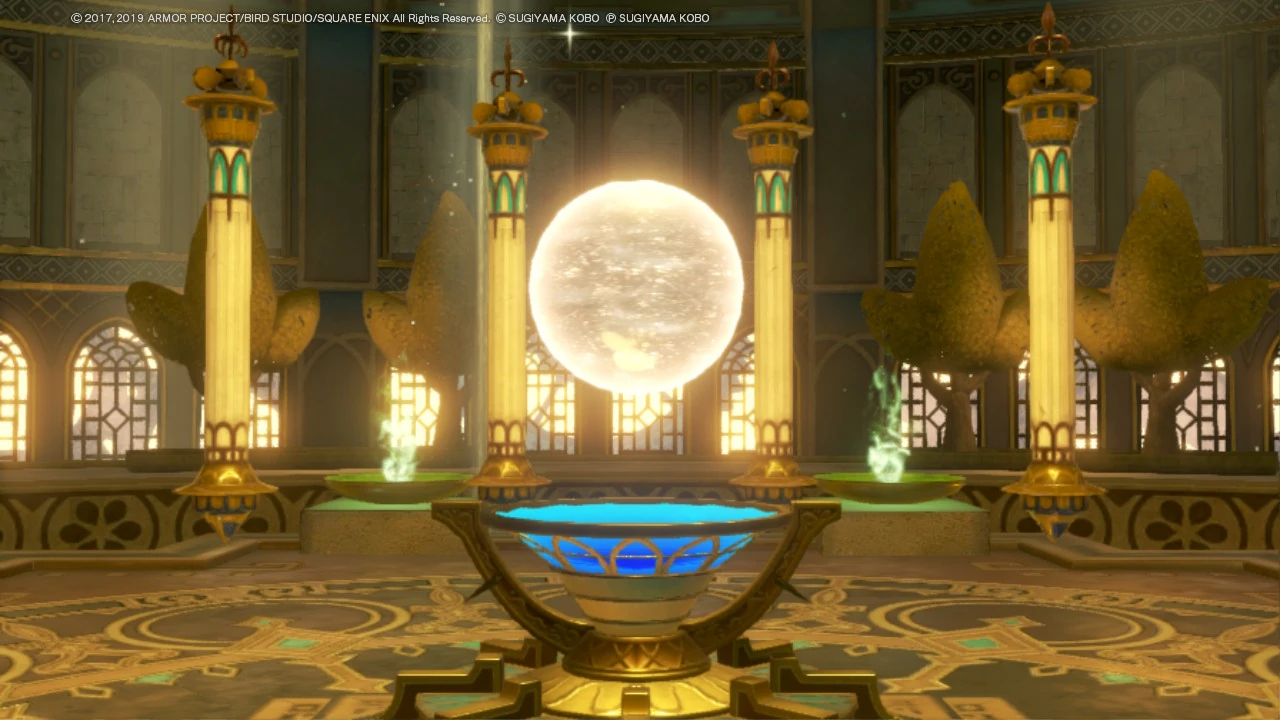
Rubiss also mentions earlier World Trees being imbued with the life force of a goddess and a Dragovian, possibly Celestria from 9 and Yggdragon from 11.

The placement of 8 seems a bit haphazard, but the explanation is that it has to do with the design of the orbs. Doesn’t Empyrea specifically say that she was known as Ramia on a different world, which might mean they’re different orbs? But then, Heirs does give a specific origin story for the orbs.

For the most part, there are no estimates as to how much time passes between these games. We know that more than a millennium passes between 6 and 4, since the Zenith Dragon is born at the end of 6 and seals away Estark 1000 years before 4. Monster Monogatari refers to an event happening in the area that would later include Casabranca 2200 years before 4. We don’t know when that is relative to 6, but the world maps in those two games look totally different aside from the tower in the middle, so it’s hard to tell what would become Casabranca. Not on the timeline is Pioniria, the ancient enchanted kingdom buried in the desert of Zamoksva that’s restored by recruiting immigrants.

I have to wonder if the novelization inspired Psaro’s fraught relationship with his father in DQ Monsters: The Dark Prince, which itself explains some elements from 4 but contradicts others. The idea that several years pass during the tunnel excavation in Chapter 3 is interesting, but I find it unlikely, since nobody seems to age in that time. And the novelizations of the Erdrick Trilogy indicate that 723 years pass in between 3 and 1, which seems like a lot considering that the town layouts are largely the same in both. Then it’s only another hundred years until 2.
We also don’t know how many different worlds are involved, but we do know that there have been cataclysms that have reshaped the layout of at least one of them. Supplemental materials incorporate both Atlantis and Mu into the DQ3 world, as well as orichalcum, which Plato identified as a substance that came from the former.

The Shield of Heroes is said to be made from mithril, which was invented by J.R.R. Tolkien. I wonder if the writer of Item Monogatari intended to tie mithril to Mithra, the chief of the gods in that story.

I’m pretty sure there’s no actual connection, as “mithril” is Sindarin for “grey-glitter” and Mithra was a Persian deity whose cult gained popularity in Rome around the same time as Christianity.
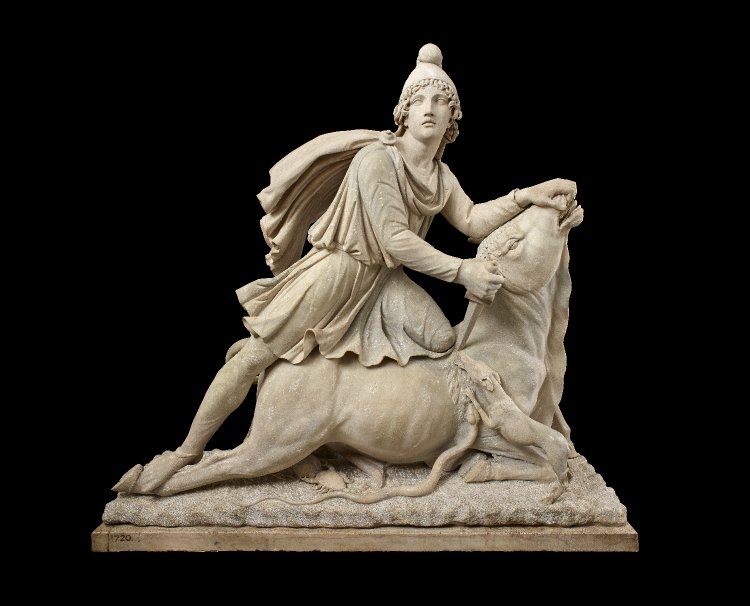
That’s probably why Robert E. Howard used the worship of Mithra as the equivalent of Christianity in the Hyborian Age. That account does seem to be contradicted by the implication in 11 that the Sword of Light is the same as the Sword of Erdrick/Kings.

Another god in the supplemental material is Ra, the first owner of the mirror that shows true forms.

I noticed that this item doesn’t appear in 8, but something called the Sun Mirror does, and Ra was the Egyptian god of the Sun.

That might not have been intentional, though.

And the DQ7 manga adaptation, Warriors of Eden, indicates that the Prince of Midenhall was the founder of Estard. I also know that the HD-2D remake of the Erdrick Trilogy makes some extra connections between the three games, including expanding the role of Hargon into someone who worked at the Dragon Queen’s court and raised the Dragonlord.
The timeline makes a reference to a manga called Hiden Ryuo BariBari Tai in the magazine V Jump, which has the Dragonlord’s sister turning people into monsters. Doesn’t 3 imply that the Dragon Queen laid only one egg? Maybe they were twins. I swear I remember someone posting a picture of the Dragonlord’s sister online, but I can’t find it now.
I’ve been wanting for years to write something about the further adventures of Erdrick after DQ3, based largely on how you see his grave in the original English version of FF1. It would also tie in elements from other game series, likely including my dream that combined Alefgard and the End of Time from Chrono Trigger into a single place. MoE identifies Erdrick’s children as Loran, Carmen, and Flora; but I don’t think it identifies their mother. There is apparently a novel that says Erdrick married the daughter of Pimiko, the ruler of Jipang who was killed and replaced by the Orochi. My idea that wasn’t really based on anything other than combining DQ and FF was that his wife was the daughter of Cecil from Final Fantasy IV, and while he has only the one son in The After Years, he’s young enough to have had more children after that.

After Years is another game I either need to finish or at least look up how it ends.
 VoVatia
