| |
My thoughts are with everyone around the world who have recently lost loved ones from any cause but especially the many unnecessary deaths that happen every day. Latest news of the injured and dead from the terrorist attack in central London: twelve Britons, three French children, two Romanians, four South Koreans, two Greeks, and one person each from Germany, Poland, Ireland, China, Italy, and the United States. Three police officers were also hurt, two of them seriously. London remains one of the world's most cosmopolitan cities, currently with a democratically elected English Muslim mayor, and that's why extremists who believe human beings should be segregated by religion, or "racial" appearance, or place of origin, hate London and target Londoners (whether they're residents or visitors). The same is true of Birmingham. Composed upon Westminster Bridge, September 3, 1802Earth has not anything to show more fair: Dull would he be of soul who could pass by A sight so touching in its majesty: This City now doth, like a garment, wear The beauty of the morning; silent, bare, Ships, towers, domes, theatres, and temples lie Open unto the fields, and to the sky; All bright and glittering in the smokeless air. Never did sun more beautifully steep In his first splendour, valley, rock, or hill; Ne'er saw I, never felt, a calm so deep! The river glideth at his own sweet will: Dear God! the very houses seem asleep; And all that mighty heart is lying still! This entry was originally posted at http://spiralsheep.dreamwidth.org/610999.html and has  comments Please comment there using OpenID. comments Please comment there using OpenID. | | |
|
I went to the theatre to see Nell Gwynn by Jessica Swale. The play is a frothy mix of Restoration It Girl biography, feminist history, discussion of playwriting, flamboyant musical numbers, and occasional outbreaks of 21st century political commentary*, which was well put together and performed so I enjoyed it. Middlebrow populist feminism FTW, obv. Unfortunately my seat was next to a seat occupied by adolf the manspreader who seemed determined to annex my legroom for the fatherland (for sausage "fatherland" read hostage "patriarchy", clearly). You should visualise him as a middle-aged white man wearing jeans and a double-vented sports jacket. He also kept glancing towards me, which I ignored with the specific form of resting bitchface which communicates the message that I will not allow the ignoree any of my attention. After the interval I returned to my seat to find the side-flap of adolf the manspreader's jacket draped over my armrest AND MY SEAT. I don't know how mr manspreader expected me to react, probably with my attention and a request for him to remove his accoutrements from MY SPACE that I had paid for, but I suspect it hadn't occurred to him that I would regard the new depths of his uncouth social faux pas with GLEE and regard it as an opportunity for vengeance against his selfish manspreading. Trying to suppress any visible signs of my GLEEFULNESS I turned my resting bitchface up to 11 and sat firmly down on MY SEAT with my arm on the armrest so that adolf the manspreader had achieved for himself the opposite of annexing MY SPACE and instead was now pinioned in place by his own selfishness... and jacket. This left adolf with two likely options, (1) asking me to move for a moment so he could retrieve his manspreaded clothing, which would have involved him acknowledging that his jacket was in MY SPACE, or (2) performing an elaborate pantomime of foolishly dropping his programme on the floor so he could lean forwards to pick it up and try to surreptitiously free his trapped jacket at the same time. It probably goes without saying that adolf opted for foolish pantomime but alas for mr manspreader he failed to unspread his clothing from MY SPACE and so remained partially pinioned for the entire second half of the play, lol. Oh, and his jacket was the only part of him that attempted to invade my space during that time as he kept his legs entirely to himself, thus proving that he could do that easily and his manspreading was merely an expression of his arseholetude. VICTORY WAS MINE (and I dedicate this victory to everyone, of any sex or gender, who has ever suffered at the hands legs of manspreading arseholes). /an anecdote ttly worth breaking several months of radio silence, lolololol * I saw a performance in traditionally Royalist, Conservative, xenophobic Worcestershire so the pro-Brexit joke that Swale transformed into an anti-Brexit joke with a flick of her pen was probably received rather differently from a London audience reaction, lol. This entry was originally posted at http://spiralsheep.dreamwidth.org/610715.html and has  comments Please comment there using OpenID. comments Please comment there using OpenID. | | |
|
Violent racist hate attacks by violent white racists, including police officers and other representatives of the UK government, are still a regular week-in-week-out occurrence in the UK. Anyone who tries to tell you differently is a liar - a racist liar. " A major police investigation is underway after officers were captured on camera tasering a Bristol grandfather who set up a group to foster better relations between the police and Bristol's black community." The video of the police attacking Judah Adunbi was made by one of his neighbours and is widely available online (luckily because this has forced the police to drop the charges they falsified against Mr Adunbi). The following article is all quoted from source @ Bristol Post for archiving purposes. Bristol tasered man Judah Adunbi: 'The police attack was racist and I was terrified'A man tasered by police in a case of mistaken identity said he believes the incident was a racist attack by officers. Judah Adunbi, a grandfather of three, was tasered in the face by a woman police officer outside his home in Easton in Bristol on Saturday morning, after he was stopped while walking his dog. The 63-year-old's ordeal was captured on video phone by his neighbour, and the footage shows officers accusing him of being a different person, trying to follow him through the gate to his house, and then tasering him. Mr Adunbi said today how he has suffered sleepless nights after being tasered just metres from his front door. Judah claims he went through a similar ordeal involving police in 2007 in another case of mistaken identity. And believes the incident on Saturday morning around 9am was a racist attack. He said: "The first time round it could have been an accident - but a second time, that's a racist attack. I'm happy to say that. I know it was the case." The 63-year-old was returning home from a routine walk with his pet pooch Hazel when he claims the police pounced without provocation. He said: "I was just finishing my walk and coming home. Police were driving up the road and caught a glimpse of me. When they saw me I had my hood up so it's impossible for them to think I am who they were after. One of the officers came right in my face. They insisted on trying to antagonise me. I started to see red and thought it was happening all over again. I felt frightened and terrified because of what happened previously." Judah claims police tried to block him as he tried to open his back gate. He added: "She had a taser and I said: 'are you going to taser me? Because if you do so you will probably kill me'. I made my way towards the gate took my keys out and went to go through. They tried to force it open which made me release the grip I had on the gate. Then I heard this sound and felt something hit me below the lip. I collapsed on the ground. She started saying you've been tasered. I was paralysed. I couldn't speak or move and didn't have any strength in me. She then told me to get up. I knew if she fired again it would have killed me. They tried to lift me off the ground. They raised me up and leaned me up against a garage but I started to slide down. It's a grace of God that I'm still alive. She has done a very terrible thing to me," he added. Mr Adunbi says he was rushed to the Bristol Royal Infirmary by ambulance with the taser still dangling from his face. He added: "They then removed most of the loose wires. They lift me back on my feet. They tried to pull the one from my face off and realised they couldn't." </b>But after being discharged later that morning he spent the next ten hours at Patchway police station. He claims he left just before midnight and was forced to make his own way home. Mr Adunbi was charged with assaulting a constable in the execution of their duty and a public order offence, but the charges have now been dropped.</b> Stunned neighbour Tom Cherry, 39, who filmed officers confronting Judah, said their actions were an 'unjustified and disproportionate use of force'. Police chiefs have referred themselves to the Independent Police Complaints Commission over the incident. This entry was originally posted at http://spiralsheep.dreamwidth.org/610470.html and has  comments Please comment there using OpenID. comments Please comment there using OpenID. | | |
|
- Post: I'm currently awaiting the delivery of 100 owls from China (and a special snowflake, lol).  - Britain on Film: Railways, 1898-1968, (note: took me three tries to type "Britain" correctly, lol) is a compilation of archive film, mostly documentary but also romance fiction, with railway connections. My favourite was Let's Go To Birmingham, 1962, (also on youtube) which showed a train driver's view of the route from London to Birmingham compressed into five minutes and accompanied by the sort of "light classical" music that now seems only to be written for film scores. The driver was dressed in a wide-lapelled white coat very similar to those worn by milkmen in my childhood. Other things I noticed in historical order: 1898: some old rail journeys are still classic rides. 1899: kissing was surprisingly kissy ( Kiss in the Tunnel and KitT remake, also 1899). 1937 and 1954: the English countryside looked markedly different when the hedgerows were replete with elm trees (cue Lumberjanes: "Suffering Johanna Westerdijk!"). 1937: I pitied the women forced to wear fashionably paltry hats which despite their meagreness managed to give them dreadful hat-hair, especially at a time when hats were unavoidably de rigueur. OH THE HORROR. 1954: Paul le Saux is no WH Auden. 1962: the view of Birmingham city centre from Bordesley viaduct has utterly changed and yet I still recognised it from the old red brick factories on the approach through Digbeth. 1963: the experimental jazz soundtrack and art cinematography of Snow couldn't have been a more complete contrast with the previous documentary's 1950s "modern" style. I recognised the BBC Radiophonic Workshop's contribution to the musical effects and was pleased to see Daphne Oram credited. Snow was also the first archive film we were shown that included a Black British railway worker, albeit only his hands! 1968: the era when men displayed the worst hair and hats. John Betjeman's wry commentary provided an excellent finish though and the audience applauded at the end of the screening.  - So, what are you doing, thinking, wondering about, reading, watching, making, or writing, that you don't usually post about? This entry was originally posted at http://spiralsheep.dreamwidth.org/609802.html and has  comments Please comment there using OpenID. comments Please comment there using OpenID.- Tags:black history: 1900s, black history: british, consumption, dora the explorer, films, hattitude, history, music, post, smut, so british it hurts, steam engines, surreality
| | |
|
 - I saw the film Paterson, by Jim Jarmusch, 2016, which is a loving tribute to the art in everyday city life as found through walking, public transport, sitting and being with the city and its inhabitants, and also through home decor, popular music, and baking. I have a love/hate relationship with Jarmusch's films and this one even has a manic pixie dream girl, which is a trope I usually dislike, but in Paterson the trope has been rewritten so she's working class and has a workable business plan through which to express herself. ♥ (5/5)  - Reading, books 2016, 217216. Lise Lillywhite, by Margery Sharp, 1951 but set in 1946-8 or so, is a romance novel about a 17-18 year old heroine seen from the perspective of her much older male cousin, and by an author who emphasises the importance of character over plot although the plot is fully functional and more complex than most genre romances. (4/5) • Lol: Susanna's bosom heaved in turn - really, thought Martin, it was like sitting between a couple of gasometers. • Punning names include: Lillywhite, obv, Lord Mull who makes a mull of things, and a duffer named Mr Duff, which leaves me wondering about the significance of Stanislas Dombrowski. 217. Redacted first novel by subsequently bestselling author, another romance novel that did nothing for me except cause constant irritation, lol, so I can't rate it fairly although it's probably technically better than most similar novels in its genre and sub-genre in every way. Nonetheless it took me two whole weeks to read 350 pages and I nearly dnfed the book because it was straining my eye-rolling muscles. This entry was originally posted at http://spiralsheep.dreamwidth.org/609610.html and has  comments Please comment there using OpenID. comments Please comment there using OpenID. | | |
|
My book stats, 2015. My book stats, 2014. I'm not planning on doing this again because three years and five hundred books is more than enough, lol. Rounding errors mean some stats probably add up to 101% or 99%, obv. In 2013 I was asked some questions about general trends in the types of books I read so I began recording some stats. The following categories are flexibly defined and I picked them because they’re relatively easy to track. I've noticed that other people tracking their stats seem more focussed than me on author stats, whereas I feel more driven by my interest in the content (subjective perception, obv, but I note that my original list of stats to collect has fictional characters ahead of authors). In 2015 I began paying attention to how much book-form fiction had women over forty as the primary point-of-view character and, as you've probably already guessed, the answer is unimpressive at 28/217 or 13% in 2016, although there were more (+7=35) who were secondary or tertiary pov characters or major supporting characters. As I'm almost certainly biased in favour of this demographic this result is notably low. Margery Sharp (4), Alan Plater (4), and Ed Brubaker (4) accounted for nearly half the books in this category, although David Hare's back catalogue is also worthy of mention and, counted as a genre, randomly selected plays by white male English playwrights represented women over 40 especially well. ( Enumeration...Collapse )This entry was originally posted at http://spiralsheep.dreamwidth.org/609462.html and has  comments Please comment there using OpenID. comments Please comment there using OpenID. | | |
|
- Happy solstice! ::waits for midwinter sun to renew:: And today's photos postulate the following questions.... (1) Robin or penguin? (2) How can a plastic sheep look so much like Tom Baker playing the fourth Doctor?  - A Doctor Who themed pocket watch (cheap Chinese knock-off) had this warning in the product description: "If your surrounding environment has a magnetic field, it will effect time." ::adds to wishlist::  - Yesterday, I heard I Wish It Could Be Christmas Every Day, by Wizzard, and I now feel officially seasonal. :-D BEST CHRISTMAS SONG EVER!!1!! /sorry Slade fans - Reading, books 2016, 216210. Something Light, by Margery Sharp, 1960, very lightweight and possibly the closest to a conventional romance novel that Ms Sharp wrote. The heroine is a career woman in her thirties who suddenly decides she wants to get married to a rich man and have a family. Nonetheless this isn't typical chicklit for either 1960 or 2016. The ending is rushed, despite having been set up and seen oncoming for most of the novel, and very much a tacked-on trope but I can forgive that in exchange for the amusing insight into human nature contained in the three main storylines. (3.5/5) • On a block of bachelor flats: [...] upon the walls, instead of horns and skulls, hung steel engravings - but each commemorating some disaster to British arms. ( The Charge of the Light Brigade, the Loss of the Royal George, the Retreat from Corunna.) Louisa passed appreciatively between them, identified the door she sought, and used the Death of Nelson as a mirror to powder her nose. 211. [redacted], 1980s, poetry written for performance, not the page, and doesn't work at all out of its original contexts. (ARGH/5 but I note the author was a Poet Laureate in her home country 16 years later) This entry was originally posted at http://spiralsheep.dreamwidth.org/609145.html and has  comments Please comment there using OpenID. comments Please comment there using OpenID. | | |
|
[Full text of article for archiving purposes. Source.] Dear Peter, all your protest achieved was to detract from women's issuesMonday, 12 December 2016 12:26 PM An open letter to Peter Tatchell from historian Louise Raw. ( Full text of article for archiving purposes.Collapse )In conclusion, Peter, the Tories must be delighted with you. No wonder people are speculating on social media that, as a prominent member of the Green party, your real aim was to damage Corbyn. You have seriously delayed and derailed a major intervention for women's – for human - rights, whilst not helping one single terrified Syrian civilian to sleep safely in their bed. Dr Louise Raw is a historian, journalist, speaker and campaigner. She appears on television and radio, is the author of Striking a Light (Bloomsbury), and organises the annual Matchwomen’s Festival in London (next 1st July 2017) This entry was originally posted at http://spiralsheep.dreamwidth.org/608891.html and has  comments Please comment there using OpenID. comments Please comment there using OpenID. | | |
|
- Happy pre-solstice night! - My soundtrack for the last astronomical day of 2016(-ish): Money don't matter 2 night, by Prince, 1991: "That's when you find out that you're better off / Makin' sure your soul's alright / 'Cause money didn't matter yesterday, / It sure don't matter to night."  - So, what are you doing, thinking, wondering about, reading, watching, making, or writing, that you don't usually post about? - Reading, books 2016, 216206. Bandette, vol.3, House of the Green Mask, by Paul Tobin and Colleen Coover, 2016, another fun story enhanced by art that not only tells the story but is also full of delightful additional detail. I especially loled at the man named Shropshire Warrington-Yorks. (5/5) • Bandette on her wannabe assassin: "[...] the deadly woman known as Madame Revolver, could shoot a fly at one hundred paces... should she for some reason be angry with this hypothetical fly." 207. Faith, vol.2, California Scheming, by Jody Houser and Pere Perez, 2016, the ongoing comic featuring plus-sized Los Angeles superheroine Faith has kept the chipper but otherwise average fangirl personality from the original miniseries and added some genre-style snappy one-liners in a very effective minor tweak to the writing that works extremely well to balance the emotional feel by preventing the fight scenes from coming across as too light-hearted, but without adding any faux-edgy bull which Faith doesn't need to go anywhere near due to already skillfully reshaping multiple superheroine genre conventions (and I'm using the words "reshaping" and "conventions" deliberately there, lol). If you like the superhero genre and fangirls then you'll probably like this. (5/5) • Baddies gotta monologue, lol: "I thought I could combine my desire to be a supervillain with my love of community theater." • One-liner monologue retorts for social justice... Wannabe supervillain: "Let me guess: you're going to say I'm insane." Faith/Zephyr: "No. I was going to say you're a smeghead." ( Two more books and a photo.Collapse )This entry was originally posted at http://spiralsheep.dreamwidth.org/608664.html and has  comments Please comment there using OpenID. comments Please comment there using OpenID. | | |
|
- I saw a late 1920s Morris Cowley car parked in a Cotswold village on the only occasion I've set foot in the Cotswolds between Oxford and the Vale of Evesham for many years. The car is, of course, a very similar model to the one Tolkien used to drive through the area on visits to his family. At least I'm not being haunted by CS Lewis or Charles Williams, lol.  - Reading, books 2016, 216204. Rosa, by Margery Sharp, 1969, is a novel about the life of a South American/English woman from childhood to old age (and possibly death or possibly not as the ending is deliberately ambiguous). It's another of Ms Sharp's genre-bending middlebrow stories. I don't know how to describe it or what to say about it at all, except that it's as if the author took her 1965 novel, the Sun in Scorpio, and then told a very similar life story as it would have played out with a differing set of character/authorial choices, and ended up with a startlingly different plot. In the hands of most writers this would be the cheapest of cheap satires but Sharp is more creative than that. Anyway, I bet this is amongst the last of Margery Sharp's novels to be reprinted. (4/5 for the authorial skill, although I have no idea what to make of the story) 205. British Subjects, by Fred D'Aguiar, 1993, is poetry with a witty cover to match the title. • This is not the season for roses everyone said, you must have done something to procure them. I argued I was simply flashed down and the roses liberally spread over my face and body to epithets sworn by the police in praise of my black skin and mother. This entry was originally posted at http://spiralsheep.dreamwidth.org/608343.html and has  comments Please comment there using OpenID. comments Please comment there using OpenID.- Tags:americana, anti-racism, black history: 1900s, black history: british, book reviews, dora the explorer, infernal combustion, literature, margery sharp, poetry, political policing, so british it hurts
| | |
|
 - I've now seen all the currently running Manor steam locomotives in motion, albeit not all on a railway.... Meet 7822 Foxcote Manor exiting Llangollen on a lorry trailer. I saw the missing tender reappear, by the same method of transport, from my breakfast table a couple of days later, lol.  - When I was searching for the book Going Home by Alan Plater, ebay suggested a blue and white china plate depicting a steam train which amused me enough that I told everyone about it. Guess what's turned up as a Winter Solstice present for me from a friend? GLEEEEEE! 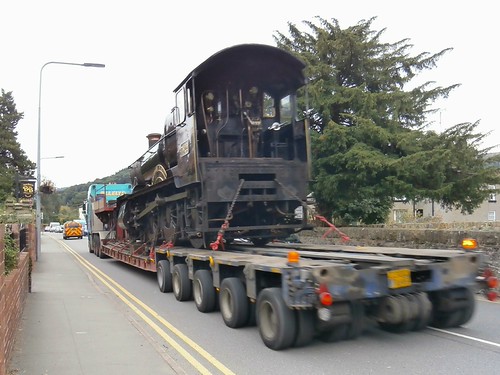 - Reading, books 2016, 216: I'm running out of year in which to post my book log so here are seven paragraphs for seven play scripts, 1966-1997, by four authors (all bona fide Northerners, including the Scot! ;-P ). ( Seven plays for more than seven players.Collapse )This entry was originally posted at http://spiralsheep.dreamwidth.org/608169.html and has  comments Please comment there using OpenID. comments Please comment there using OpenID. | | |
|
- St John the Baptist church, Beckford, has some unusual C12th stone carvings including a centaur with a spear ( another view for context) apparently intended to resemble King Stephen's coat of arms. A depiction of the "Ransom Theory" better known in English lore as the Harrowing of Hell represented by an image of Jesus stabbing a wolf's head with a cross while he fishes (LITERALLY) someone out of the underworld ON A HOOK, OW! [ click for stabby hooky Jesus embiggened] 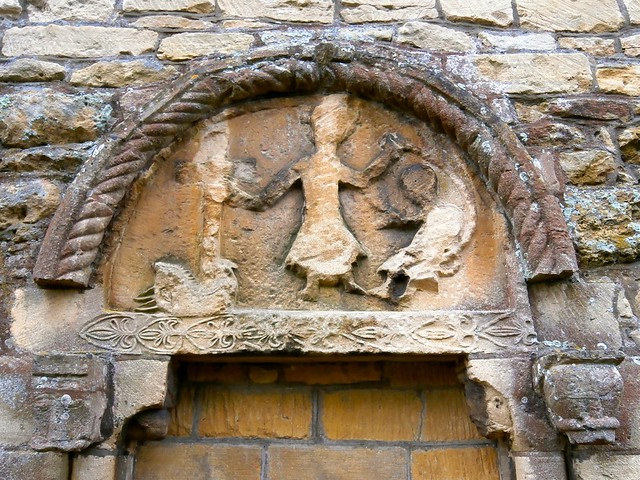 Although my personal favourite is the tympanum over the main door in the south porch which appears to depict a cross supporting a vulture and the sacred Last Rolo ("Do you love anyone enough to give them your last Rolo?") watched by a donkey with four ears (right) and a unicorn with four ears (left) [ click for little donkeys embiggened]. The scholarly explanation for this last image is supposedly that it's a picture of Jesus, God, and the Holy Spirit, watched by two hoofed animals with random quantities of ears and/or horns (no, rly, lol). It's a mystery, clearly.  - Lexicophilia: I've recently been enjoying the village names of Nempnett Thrubwell, and Marston Bigot (from "by God", lol). - So, what are you doing, thinking, wondering about, reading, watching, making, or writing, that you don't usually post about? - Reading, books 2016, 216195. The Innocents, by Margery Sharp, 1972 (but set 1939-46), is a novel that examines disability and society (from a social model perspective). The narrator is an anonymous first person in her 60s and so well done it's like listening to an old friend chatting over tea, however, any genre savvy reader will realise from the beginning that our hostess is an unreliable narrator who uses the tactic of openness about the minor flaws of herself and her community to gloss over much worse, especially That One Thing Which Happened. This is my eleventh Margery Sharp novel and this narrative voice is unique so far, which I believe was a deliberate artistic choice by the author because the effect reminded me of [spoiler] similar narrators in classic murder mysteries [/spoiler]. The title refers not only to innocence/guilt but also to innocence/experience in reference to the protagonist and the learning disabled girl she is looking after, who is characterised as "simply retarded, not autistic". Expanding on the novel's theme of disability within society, which is skillfully done while remaining wholly within middlebrow literary traditions, the cast also includes an off stage epileptic young man who commits undramatic suicide (a form of self harm that was a recognised at the time as a possible side effect of phenobarbital [and phenytoin]), and an on stage wheelchair user who was disabled in the Second World War but becomes a new father and is feted for doing so. We are shown, not told, about their community's helpful and unhelpful attitudes towards all these people and at least one other local who is, perhaps wrongly, deemed a malingerer instead of an arthritis sufferer (and how that accusation of worthlessness impacts negatively on the self-esteem of one of his disabled relatives). Also includes, because Margery Sharp: a likeable pioneering woman vet, a strongly positive portrayal of a woman doctor, and a brief moment of anti-anti-Semitism. (4/5 maybe 4.5/5) • On polite silences... or otherwise: [...] I waited for Mr. Hancock to continue in I hoped impolite silence. • Lol: Of course with so much ground I need to employ a gardener two days a week, but am happy to say he is not a character. • The protag is haunted by The Luggage: [...] I felt the twin brass locks of its eyes regard me ironically. [...] I do not often dream, but it must have been in dreams that for several subsequent nights I heard the words "Ootacamund, Delhi, Simla," then "Delhi, Simla, Ootacamund," pronounced in a deep, leathery voice. This entry was originally posted at http://spiralsheep.dreamwidth.org/607986.html and has  comments Please comment there using OpenID. comments Please comment there using OpenID.- Tags:book reviews, disability rights, discworld, dora the explorer, gothicism, history, lexicophilia, literature, margery sharp, so british it hurts, surreality, xtianity
| | |
|
- When I read posts about television series I don't watch then I sometimes internally pretend to misread them as being about the poster's everyday life. /little things - Cute rediscovered library book story: " Overdue library book returned to school 120 years late (BBC News online)" [...] "The Microscope and its Revelations, by Dr William B Carpenter, was borrowed by former pupil Professor Arthur Boycott, who attended Hereford Cathedral School between 1886 and 1894. It was discovered by his granddaughter Alice Gillett. The school has promised to waive any fines - which based on the rate at Hereford Library of 17p a day, would have amounted to a staggering £7,446." [...] "The book would have been of good use to young Boycott as he eventually graduated with first class honours in Natural Science and became a distinguished naturalist and pathologist." - I was already going stir crazy and it's only the beginning of winter here so I took advantage of a warmer day and went for a walk in the Cotswolds. I caught a bus through the villages in the morning, admiring the glorious yellow oolitic limestone buildings and thatched roofs topped with bird sculptures, and then back again in the evening, admiring the bravery of any resident who dared to display tacky xmas lights: my favourite was the white-fronted building used as a screen for THREE disco-light projectors (I'm reasonably sure this breaks every rule in whatever conservation area they live in and possibly also several local by-laws, lol). The sky was still pink with dawn at midday and there were only a couple of hours of true daylight before the sun dipped down into a splendid sunset. The footpaths, where passing feet have worn down to rock, are yellow too. When I was at 120m altitude I saw a low flying plane just showing sky against a background of a 220m hill about 7km away. It looked similar to a medium sized passenger jet and banked towards RAF Brize Norton ( click through for largest image). ETA: C-130J Hercules @ RAF Brize Norton, and 130J Super Herc @ wikipedia.  I saw an (old?) Airstream caravan in a farmyard.  The sunset over Beckford Stores from the bus stop bench was magnificent and my cap doesn't do it justice.  This entry was originally posted at http://spiralsheep.dreamwidth.org/607359.html and has This entry was originally posted at http://spiralsheep.dreamwidth.org/607359.html and has  comments Please comment there using OpenID. comments Please comment there using OpenID. | | |
|
- FREE LOVE this way →  - Reading, books 2016, 215192. Martha in Paris, by Margery Sharp, published 1962 but set earlier (the internal dating evidence places it as 1941ish but that's not possible because of the war, obv [/having UNIT dating controversy flashbacks] ), is the second novel in the Martha trilogy, after Eye of Love, about a young artist (who the author might or might not have intended to be read as at the Asperger end of the autistic spectrum but certainly non-neurotypical). It's a very entertaining character study, but would probably only be fully appreciable after reading Eye of Love. (5/5) • I might over-empathise with this attitude to learning français to converse with Parisians, lol: [...] she learned to speak practically no French at all. She learnt to understand it; but discovering, for example, that when she said 'no', people understood just as well as if she'd said ' non', left it at that. It wasn't as though she had anything she particularly wanted to say. The power of expressing thoughts, or emotions, was unnecessary to her; and not to be able to answer questions a positive advantage. • Although the meaning was clear from context I had to look up "esurient", which means greedily hungry. • pg134: dialogue including use of the n-word in this idiomatic phrase (note: idiomatic usage of the n-word had disappeared from "polite" speech in England before my childhood, except for the choosing rhyme eeny meeny miney mo, but phrases such as "work like a Black" to mean "work exceptionally hard" were still common). I wonder if the recent USian e-book edited the phrase. 193. Martha, Eric, and George, by Margery Sharp, 1965 but set earlier (the internal dating evidence places it as 1950ish), is the third and last novel in the Martha trilogy. Part one is social comedy then part two is feminist wish fulfilment, and all the better for that: if you're going to do wish fulfilment then do it well. Martha, however, remains fully Marthary and except for a single brief moment is never a true mary sue. (4/5) • pg72 is a mess mixing an inaccurate but flattering encomium in praise of fat women's skin (even, pearly, and satiny) with some orientalism about artistic representations of Buddha (narrow eyes in a fat face) and the supposed characteristics of Manchu empresses (strong-willed, ruthless, and formidable). • Ms Sharp quasiquotes John Tobin: The man that lays his hand upon a woman, / Save in the way of kindness, is a wretch / Whom't were gross flattery to name a coward. • pg138 uses the word "feminist" positively and includes a gloriously snide comment on competing mainstream and radical ideals of feminism: “Eric doesn't know it yet, but I'm really a terrific feminist,” explained Edith — shooting her beloved nonetheless a reassuring glance. “I dare say it's because our school had such a wonderful Head; who always taught us that one woman's achievement should be a pride to all. Oh, Martha — may I call you that? — wouldn't it be wonderful if you were ever damed?” [spiralsheep's note: for her services to art]
Martha, dimly perceiving amongst all this rigmarole something emerging to her advantage, grunted encouragingly.
“And of course you couldn't be, could you, if everyone knew you'd a . . . little illegit.," pronounced Edith daringly. “I believe they're terribly strict about these things! — And I've been thinking and thinking, ever since Mrs Taylor talked to me; and though Eric may think you heartless, what I think is how wonderful of you, to give up your only child to strike a blow for all women everywhere.
Before this rewarding gloss on her conduct Martha could only sit silent, digesting it. (Without remarking, for example, that what would really strike a blow for women would be for one to turn up at an Investiture accompanied by half-a-dozen little illegits.) This entry was originally posted at http://spiralsheep.dreamwidth.org/607052.html and has  comments Please comment there using OpenID. comments Please comment there using OpenID. | | |
|
- Fossils on Ynys Echni, aka Flat Holm island, the southern point of Wales in the Bristol Channel: (1) trace fossils or geology, I dunno, (2) fossilised ripples, (3) a ancient member of the evil gastropod conspiracy from the dawn of time!!1!!  - The Lion, the Witch, and the Wardrobe: if we're pretending this is based on a pre-existing religious story (did C.S. Lewis explicitly endorse this reading anywhere?) then it's closer to a perversion of the story of lion-powered, underworld-visiting, Inanna/Ishtar as Aslan with her sister Ereshkigal miscast as Jadis than it is to Jesus versus the Devil, surely? Also, if Lewis had intended a specifically Christian allegory then he presumably wouldn't have given the baddie Jadis a name so close to Jesus? I vaguely tried googling to find if anyone else had suggested this but the results weren't promising so YOU HEARD IT HERE FIRST (or probably not). ALSO does the propaganda shovelled out by well-known fraudster Donald Trump's "deplorable" supporters count as "Deplorable Words" that will end all life except theirs? ;-)  - Reading, books 2016, 214191. Goldie Vance, vol.1, by Hope Larson, Brittney Williams, and Sarah Stern, 2016, is a girls' own graphic novel featuring 16 year old girl investigator Marigold "Goldie" Vance, who works as a parking valet at the Florida resort hotel managed by her father. This book contains a completed mystery story with several subplots, all of which work, and introduces a whole cast of fully fleshed-out characters. It's set in about the early 1960s but this is a fictional Golden Age past as seen through a mildly genre-skewed lens of girl investigator meets detective/spy/science fiction/romance. The primary romance is lesbian, the protagonist is Black (mixed race as her mother is a mermaid white, although she lives with her Dad who is Black), the first white character is introduced on page seven, and although the art is classicly toony people's body shapes are more realistic than not. Brittney Williams' art is perfect on every page and I was sold on this comic because the kid's facial expressions in panels 3-5 made me laugh even before the scene was set and the characters were introduced (also reminded me of Giles and other classic comic strips). Sarah Stern's colouring is good too with many pages featuring people with widely varying but realistic skin-shades. (5/5 and 5 preview pages at The Mary Sue) • On a choice of leisure destination, lol: "Lime Street? Why not! We always see someone we know." LOL, yes. [/in-joke]  This entry was originally posted at http://spiralsheep.dreamwidth.org/606729.html and has This entry was originally posted at http://spiralsheep.dreamwidth.org/606729.html and has  comments Please comment there using OpenID. comments Please comment there using OpenID. | | |
|
- Disability rights, UK, reminder: if you receive disability benefits from the UK government (e.g. the DWP) then from 29 Nov 2016, i.e. last week, you will probably be safer from snooping by using a VPN connection for ALL your internet browsing: at home or via a mobile device. Also remember that no library internet connection has any security from snooping by the DWP &c. Using a VPN doesn't protect you from being specifically targetted for surveillance if you're under suspicion of criminal activity, obv, but it's currently the first line of defence against casual opportunistic snooping being applied to every disability benefits claimant. People who don't use VPNs will be at the top of the list to be snooped first because they're easier targets. This is even more important for disability activists who might already have come to the attention of the DWP and could be prioritised for snooping. Imagine being subjected to losing your benefits indefinitely until a tribunal appeal at which your reading of [example1: sports websites] or [example2: travel websites] is held up as evidence against you, especially because the evidence is currently limited to the name of the website only, and you would need to immediately justify your participation in convincing evidential detail. This isn't some vague dystopian future. This applies NOW. Don't risk being a test case. - The frost here last week was thick and white enough at midday to look like snow for two days running! - Reading, books 2016, 211189. The Faithful Servants, by Margery Sharp, 1975, is a novel, or suite of interconnected short stories, beginning in 1860 and continuing through to the early 1970s. It isn't Ms Sharp's best novel but it's a wide-ranging look at the subject of women in household service outside the context of work, which is at least as interesting for its perspectives on social history as for the characters and their stories beginning with a brief mention of Victorian lesbians (which is the best way to begin, obv). The end brought sentimental leftist tears to my eyes. (3.5/5) • Although the meaning was clear from context I had to look up "defalcate", which means embezzle. • pg 65 & 71 & 77 & 78 A Black sex-worker popular with upper class clients in pre-First World War London (and again I wonder when the incorrect meme claiming there were no Black people in England began and spread despite the influence of popular bestsellers relating more realistic histories). • Am I allowed to count Hugh Wycombe as a joke name? /High Wycombe • pg 132-146 three mixed race children, including 13 year old Myrna (and creepy white people who want to exploit her sexually). • pg 165 Casual mention of a German Jewish refugee. • pg 187 In praise of the Beveridge Plan, i.e. National Health Service and Social Security, aka the "Welfare State". • pg 194 Mention of abortion on the National Health. • pg 202 Miss Alice Pettigrew, lady's maid, receives charity (which might be a comment on another well-known novel because that's part of Ms Sharp's observational style). ( Imprudence, by Gail Carriger (1/5)Collapse )This entry was originally posted at http://spiralsheep.dreamwidth.org/606661.html and has  comments Please comment there using OpenID. comments Please comment there using OpenID.- Tags:anti-racism, black history: 1800s, black history: 1900s, black history: british, book reviews, conservatives hate poor people, disability rights, feminism, his chandelier only has one lightbulb, history, judaism, literature, margery sharp, political policing, sensawonder, skiffy (non-who), so british it hurts, teh interwebz
| | |
|
 - This poem has been one of my favourite Elizabethan lyrics since I was a teen. I recently heard twelve highly trained classical singers sing this song, published in 1600, about volcanoes and flying fish. ( This version by the Hilliard Ensemble is much stiffer and with less clear enunciation but it'll do.) Thule, and The Andalusian merchant, by Anon (music by Thomas Weelkes) Thule, the period of cosmography, Doth vaunt of Hecla, whose sulfurious fire Doth melt the frozen clime and thaw the sky; Trinacrian Aetna’s flames ascend not higher. These things seem wondrous, yet more wondrous I, Whose heart with fear doth freeze, with love doth fry. The Andalusian merchant, that returns Laden with cochineal and China dishes, Reports in Spain how strangely Fogo burns, Amidst an ocean full of flying fishes! These things seem wond'rous, yet more wond'rous I, Whose heart with fear doth freeze, with love doth fry.  - Reading, books 2016, 208187. Laughing All the Way to the Mosque, by Zarqa Nawaz, 2014, is a set of autobiographical-ish essays, written for laughs, all on the theme of living as a Muslim in contemporary Canada, by the creator of acclaimed sitcom Little Mosque on the Prairie. The subjects range from birth to death LITERALLY and are relatively simple but engaging exercises in explaining "modern" western Muslims (not Islam) to "white people" [sic], specifically Muslim immigrants from South Asia and their children to non-Muslim white westerners, through the medium of comedic self-deprecating family stories. (4.5/5 does what it aims to do and does it well, although it's too close to self-deprecating comedy-of-embarrassment at some points for my personal taste) 188. In Pious Memory, by Margery Sharp, 1967, is a satirical comedy of manners novel revolving around an upper middle class family and the effect on each individual of the disappearance of the husband, and father of adult children, in an air crash. The primary protagonist, more or less, is the wife who is another of Ms Sharp's trademark unsympathetic heroines although in this case more for her self-imposed doormat status than any other personality defect. Her three adult children, having been raised by an uncaring father and a mother devoted to her husband, have all grown up to be independent individualists and are therefore also varying degrees of unsympathetic for most readers. So, warning for mention of an air crash, accidental death, minor shenanigans with a body, minor sexual assault by six adults on two teenagers (specifically kissing and groping so nothing most teenage girls aren't forced to experience), mistaken identity, emotional manipulation, and the very English expectation that all this is lolarious if presented as a well-written comedy novel (which it is imo, with the partial exception of the creepy assault). There are no happy endings and everyone gets their comeuppance to some degree but only via consequences of various sorts of self-delusion about human relationships from which even wealth can't wholly shelter people. I laughed throughout, as the author presumably intended. (4.5/5 would probably offend most readers one way or another, lol) This entry was originally posted at http://spiralsheep.dreamwidth.org/606282.html and has  comments Please comment there using OpenID. comments Please comment there using OpenID. | | |
|
 - Write my shopping list? I have to go into the city centre for what will hopefully be my last shopping visit until 2017 but I can't seem to think what I should have on my shopping list so help me out by telling me which things you have to go especially into a large town centre or mall to buy because you can't get them locally? - My new hat, according to a friend, makes me look like a mad Edwardian lady. WIN. Another life goal ticked off my list! - Cat = chicken. I was crossing a railway bridge and looked down to see a face-off between a train in the nearby station and a black and white cat sitting neatly perched on a freezing cold rail facing the train. I told the cat, just loud enough for it to hear, "I wouldn't sit there if I were you." And, clearly realising it had been addressed it meowed back at me with a loud extended multi-syllable, "MMRRROOOOAAAWW." The driver began rolling forwards and sounded his two-note klaxon but the cat naturally ignored him until the last moment that a relaxed strolling pace would suffice to remove it from danger. I wonder how many times that terrorist cat has targetted the local transport infrastructure in this way. - Berwyn, Land of Bridges.  ( Reread book.Collapse )This entry was originally posted at http://spiralsheep.dreamwidth.org/606055.html and has ( Reread book.Collapse )This entry was originally posted at http://spiralsheep.dreamwidth.org/606055.html and has  comments Please comment there using OpenID. comments Please comment there using OpenID. | | |
|
I walked variations of "first left, second right" four times while I was in Llangollen.  1. Beginning from the bridge over the River Dee, aka Afon Dyfrdwy, and facing into town I walked first left, second right, first left, &c. I wandered up Castle Street, which doesn't lead to any castles, then first left into Bridge Street, which doesn't lead to any bridges, until it turns into Church Street which does pass St Collen's Church for whom Llan-gollen is named.  ( Eight more small images.Collapse )This entry was originally posted at http://spiralsheep.dreamwidth.org/605793.html and has ( Eight more small images.Collapse )This entry was originally posted at http://spiralsheep.dreamwidth.org/605793.html and has  comments Please comment there using OpenID. comments Please comment there using OpenID. | | |
|
|


