


 I built a clinical assistant that could summarize patient notes pretty well. Then I asked it about the same patient two weeks later, and it confidently ignored everything it had already seen.
That’s when I realized: I hadn’t built a system. I’d built a stateless loop.
What this system actually does
Clinical CoPilot is a memory-first system for primary care workflows. It takes raw visit notes and turns them into structured, recallable memory that persists across time. The goal is simple: before a doctor sees a patient, the system should already know what matters.
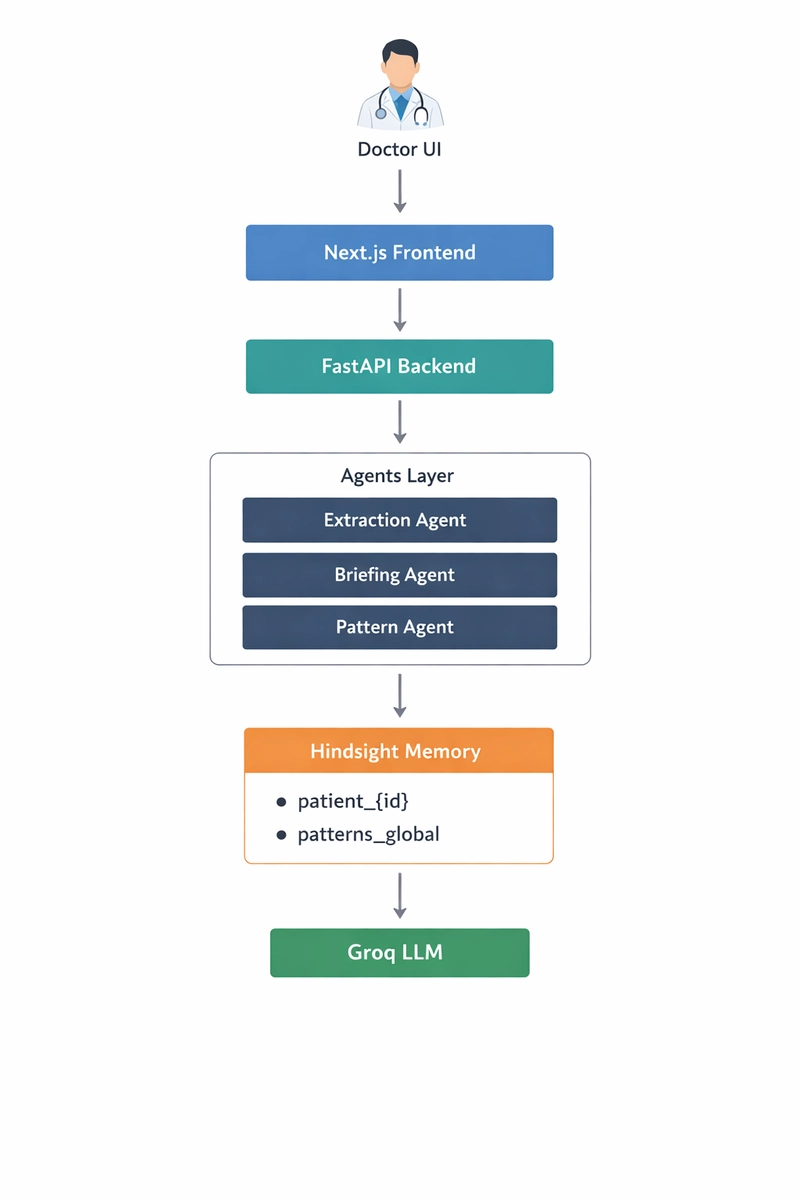
The architecture is straightforward:
A FastAPI backend orchestrates the flow
An extraction agent parses visit notes into structured memory
A memory layer (Hindsight) stores those events
A briefing agent generates pre-visit summaries
A pattern agent identifies trends across patients
Each patient has their own memory thread. Every visit adds new entries. Nothing gets overwritten.
On the frontend, I expose three things:
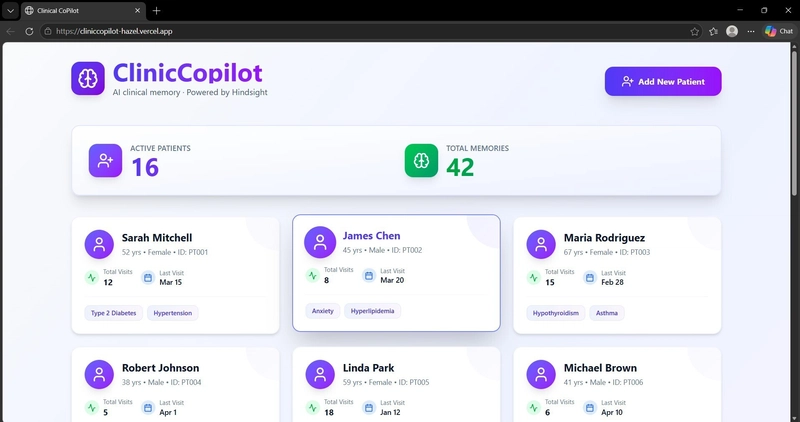
A patient dashboard
A “Memory Inspector” to visualize stored memory
A briefing panel that shows what the system thinks matters
The UI is intentionally simple. Most of the work happens in how memory is structured and retrieved.
The problem: stateless systems don’t handle time
My first version followed the usual pattern:
Grab recent notes
Dump them into a prompt
Generate output
Something like:
prompt = f"""
Patient history:
{recent_notes}
Summarize key clinical details for the next visit.
"""
This works if “recent” is enough. It usually isn’t.
Real problems:
Medication reactions from older visits disappear
Follow-up commitments get lost
Personal context (job, family, habits) never survives
I kept increasing the context window. It didn’t help. The system wasn’t forgetting because of token limits. It was forgetting because it had no memory model.
I needed a way to give my agent memory
.
Switching to memory: events instead of text
Instead of storing notes, I started storing events.
Each visit produces multiple structured memories:
Visit summary
Medication event
Personal detail
Commitment
Lab result
Family history
Example:
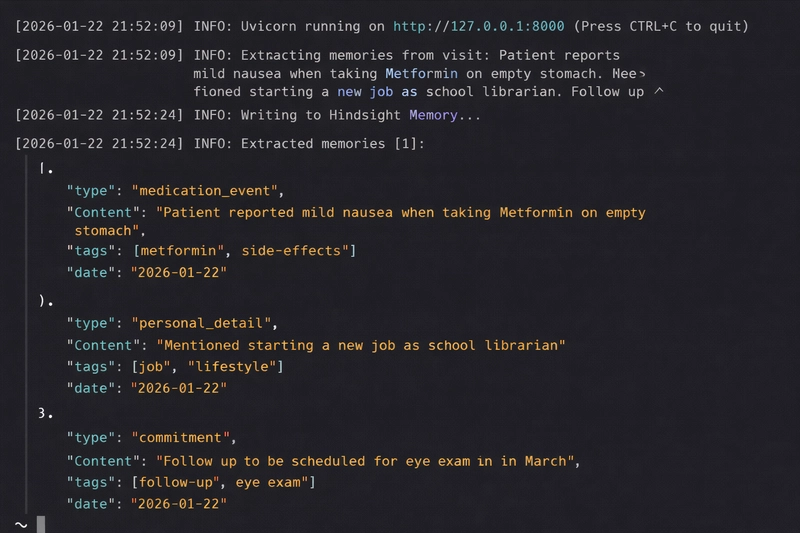
{
"type": "medication_event",
"content": "Patient reported mild nausea when taking Metformin on empty stomach",
"tags": ["metformin", "side-effects"],
"date": "2026-01-22"
}
This immediately changes how the system behaves:
You can query specific types
You can prioritize certain events
You can explain outputs
The missing piece was persistence and retrieval.
Using Hindsight as the memory layer
I decided to try Hindsight
for agent memory. I also explored the Hindsight agent memory docs
to understand how threads and recall work.
Each patient gets their own thread:
thread_id = f"patient_{patient_id}"
await hindsight.write_memory(
thread_id=thread_id,
memory={
"content": memory.content,
"tags": memory.tags,
"metadata": memory.metadata
}
)
Retrieval is semantic, but scoped:
memories = await hindsight.recall_memories(
thread_id=thread_id,
query="diabetes medication side effects",
limit=10
)
Two things mattered here:
- Threads enforce isolation
Each patient’s history lives in its own namespace. That prevents cross-contamination and keeps retrieval focused.
- Recall is query-driven
Instead of passing everything, I can ask:
“What medication issues exist?”
“What commitments are pending?”
This is much closer to how humans think.
Extraction: where things got painful
Memory is only useful if it’s accurate. The extraction step was the hardest part.
I use an LLM (via Groq) to convert raw notes into structured memory:
response = groq.chat.completions.create(
model="openai/gpt-oss-120b",
response_format={"type": "json_object"},
messages=[{
"role": "system",
"content": "Extract structured clinical memories from the note"
}],
temperature=0.2
)
Problems I ran into:
The model would over-extract trivial details
It would miss implicit commitments
Tags were inconsistent
Fixes:
Strict schema with Pydantic
Explicit examples in the prompt
Post-processing to normalize tags
Extraction is not “set and forget.”
Generating briefings: only as good as memory
Once memory is reliable, briefing becomes straightforward.
The agent pulls:
All patient memories
Relevant cross-patient patterns
memories = await hindsight.get_all_patient_memories(patient_id)
patterns = await hindsight.recall_patterns(query="diabetes risk")
Then generates a structured briefing.
The key difference:
I’m not asking the model to remember. I’m giving it memory.
What the system actually produces
Input note
“Patient reports mild nausea when taking Metformin on empty stomach. Started new job as school librarian…”
Stored memory
Medication event → Metformin nausea
Personal detail → new job
Commitment → schedule eye exam
Later: generated briefing
Today’s Focus
Review A1C improvement
Confirm eye exam scheduling
Assess impact of new job on diet
Suggested opener
“How’s the new librarian role going? Are you finding ways to pack healthy lunches?”
This is where the system stops feeling generic.
Patterns across patients
I also maintain a global memory thread:
thread_id = "patterns_global"
The pattern agent identifies trends like:
Diabetes + hypertension + family history → elevated stroke risk
Frequent visits → better adherence
Lessons learned
- Context is not memory
Passing more tokens is not a substitute for real memory.
- Structure beats embeddings alone
Without structure, you can’t prioritize or explain outputs.
- Extraction quality determines everything
Bad input → bad system. Most improvements came from better schemas and prompts.
- Traceability matters
If the system says something, you should know where it came from.
- Memory needs fallback
External systems fail. Always have a backup.
Closing
I was tired of prompt engineering and started looking for a better way to help my agent remember
.
Using Hindsight
forced me to think differently:
Events instead of text
Threads instead of prompts
Recall instead of context stuffing
Once I made that shift, the system stopped forgetting.
And more importantly, it started behaving like it understood patients across time.



Top comments (0)