


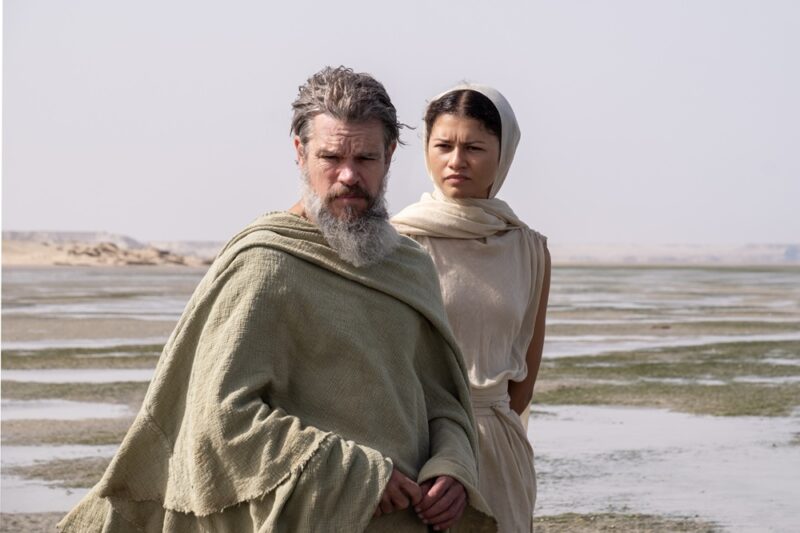
For all the technological leaps cinema has made over the last century, Christopher Nolan continues to prove that nothing rivals the tangible. The weight of real bodies. The unpredictability of crashing waves. The texture of weathered stone. The immensity of landscapes that actually exist. The Odyssey is perhaps the purest expression yet of Nolan’s filmmaking philosophy, an astonishing feat of practical filmmaking that doesn’t merely depict Homer‘s legendary tale – it places you inside it.
Shot entirely with IMAX film cameras across six countries, The Odyssey is tailor-made for the biggest screen imaginable. Every crashing tide, towering cliff face and sweeping horizon possesses a tactile grandeur that digital filmmaking rarely replicates. You don’t simply watch Odysseus traverse oceans and hostile lands – you feel the salt in the air, the sting of the wind and the physical exhaustion of every mile travelled. The commitment to shooting in real locations, with practical effects wherever possible, transforms what could have been another CGI-heavy fantasy into something remarkably visceral.
That commitment extends beyond spectacle. Nolan has long excelled at marrying blockbuster scale with intimate character study, and The Odyssey may represent his finest balance of the two. Beneath its mythological creatures, warring kingdoms and divine interventions lies a surprisingly emotional story about guilt, legacy, family and the impossible pursuit of home. The spectacle is immense, but it never overwhelms the humanity at its centre.
Matt Damon delivers one of the strongest turns of his career as Odysseus. It’s a full-bodied, physically demanding performance that asks as much of the actor emotionally as it does physically. His Odysseus isn’t simply an untouchable hero; he’s burdened by the consequences of his own decisions, haunted by war and visibly worn down by years spent chasing redemption. Damon commands every frame, grounding Nolan’s largest canvas in something deeply human.
If Damon anchors the film, Tom Holland provides its emotional heartbeat. As Telemachus, Holland delivers what is comfortably his finest work thus far. Shedding the youthful charm audiences have come to associate with him, he embraces a far more mature, layered performance as a son forced to grow into adulthood without the father he’s spent years believing dead. Holland’s evolution across the film mirrors the emotional journey of the story itself, and the confidence with which he handles the material signals an actor stepping into an exciting new phase of his career.
As Penelope, Odysseus’s long-suffering wife and Telemachus’s mother, Anne Hathaway once again proves why she remains one of Nolan’s most valuable collaborators. Beneath her measured exterior simmers years of grief, resilience and unwavering belief, and Hathaway conveys each layer with remarkable precision. It’s arguably the film’s richest female role, and she makes every moment count.
Yet for all of The Odyssey‘s triumphs, it once again exposes a criticism that has frequently followed Nolan throughout his career: his female characters rarely receive the same depth afforded to their male counterparts. Hathaway largely escapes that fate, but Lupita Nyong’o, Zendaya and Charlize Theron – all playing figures of enormous significance within Homer’s mythology (Helen of Troy, Athena and Calypso, respectively) – are afforded comparatively little screen time to leave the lasting impression their talents suggest they could. Their performances are strong, but each feels like only a glimpse of a richer character waiting to emerge.
Ironically, it’s Samantha Morton, appearing for only a single extended sequence as the witch, Circe, who leaves one of the film’s most indelible impressions. Her confrontation with Odysseus unfolds amidst some of the film’s most grotesque and unsettling imagery, yet it’s Morton’s commanding presence that lingers longest. In remarkably little screen time, she creates a character who feels simultaneously terrifying, tragic and deeply sympathetic.
Of course, no discussion of The Odyssey would be complete without acknowledging its extraordinary set-pieces. Nolan stages action with a clarity and physicality few contemporary filmmakers can match. An extended encounter inside the Cyclops’ cave is a masterclass in escalating tension, transforming a familiar myth into an exercise in sustained dread. Every shadow, every footstep and every desperate decision compounds the suffocating sense of danger until the sequence becomes almost unbearable in the best possible way.
Equally breathtaking is the film’s climactic slaughter, spearheaded by Damon with a ferocity that feels earned rather than gratuitous. It is brutal, emotionally cathartic and impeccably choreographed, delivering one of the most satisfying action sequences Nolan has ever committed to film. Rather than relying on frenetic editing, he allows geography, performance and practical stunt work to dictate the momentum, making every strike land with devastating force.
Throughout, Ludwig Göransson‘s soaring score elevates the emotional stakes without overwhelming them, while Hoyte van Hoytema‘s cinematography produces imagery of staggering beauty. Together, they create a film that feels both ancient and startlingly immediate, honouring Homer’s enduring text while crafting an experience that speaks directly to modern audiences.
In an era increasingly dominated by virtual production and artificial spectacle, The Odyssey feels almost defiant. It reminds us that there remains an irreplaceable power in seeing real actors inhabit real environments, confronting perceptible elements that no computer can fully replicate. Every creative choice, from the IMAX photography to the practical effects, serves the same purpose: complete immersion.
Nolan has never lacked ambition, but with The Odyssey he achieves something rarer. He delivers a film of extraordinary scale that never loses sight of the people at its centre. It’s violent and tender, mythic and deeply personal, intellectually rich yet endlessly entertaining. More than an adaptation of one of history’s greatest stories, it stands as one of the defining cinematic achievements of the decade.

FIVE STARS (OUT OF FIVE)
The Odyssey is now screening in Australian theatres, before opening in the United States on July 17th, 2026.

