


Welcome to Nature Notes
Last week’s Nature Notes Bloggers

| 1. | Whales & Cockatoo | 4. | Lisa | Handmade in Israel | 7. | Pat in Colorado |
| 2. | marina | 5. | Cloudia Honolulu | 8. | Betty Crow |
| 3. | Shiju Sugunan | 6. | ON THE WATER | 9. | Cloudia Honolulu |
**********************************************
Thank you for all the kind wishes. It is a slow process for me to recover from illnesses, but I am getting there. So…….
My husband actually shared this article with me from The New York Times newspaper. We have a lot of trees and many shrubs that we have planted and a lot of leaves. Fall is ripe with the sound of leaf blowers where the neighbors blow all the leaves into the street where they wait to be picked up by the town who turns them into mulch. Meanwhile they become a slippery driving hazard and force pedestrians to walk around them as we have no sidewalks.
We usually rake the leaves, put them on a tarp and haul them across the pond where they compost. But this article has us trying a new way. I happen to talk to a master gardener who was talking about this article and she always chops her leaves up but she doesn’t want to do that now. Why? The leaves are full of invertibrates including: spiders, insects, butterflies and moths. We are killing the insects and removing an important resource for the soil.
Read the article if you like. It is an interesting story about the biodiversity that we have in our own yards. The normal lawn yard here with all the leaves blown away is devoid of like. Maybe I can be a little island in that vast desert.
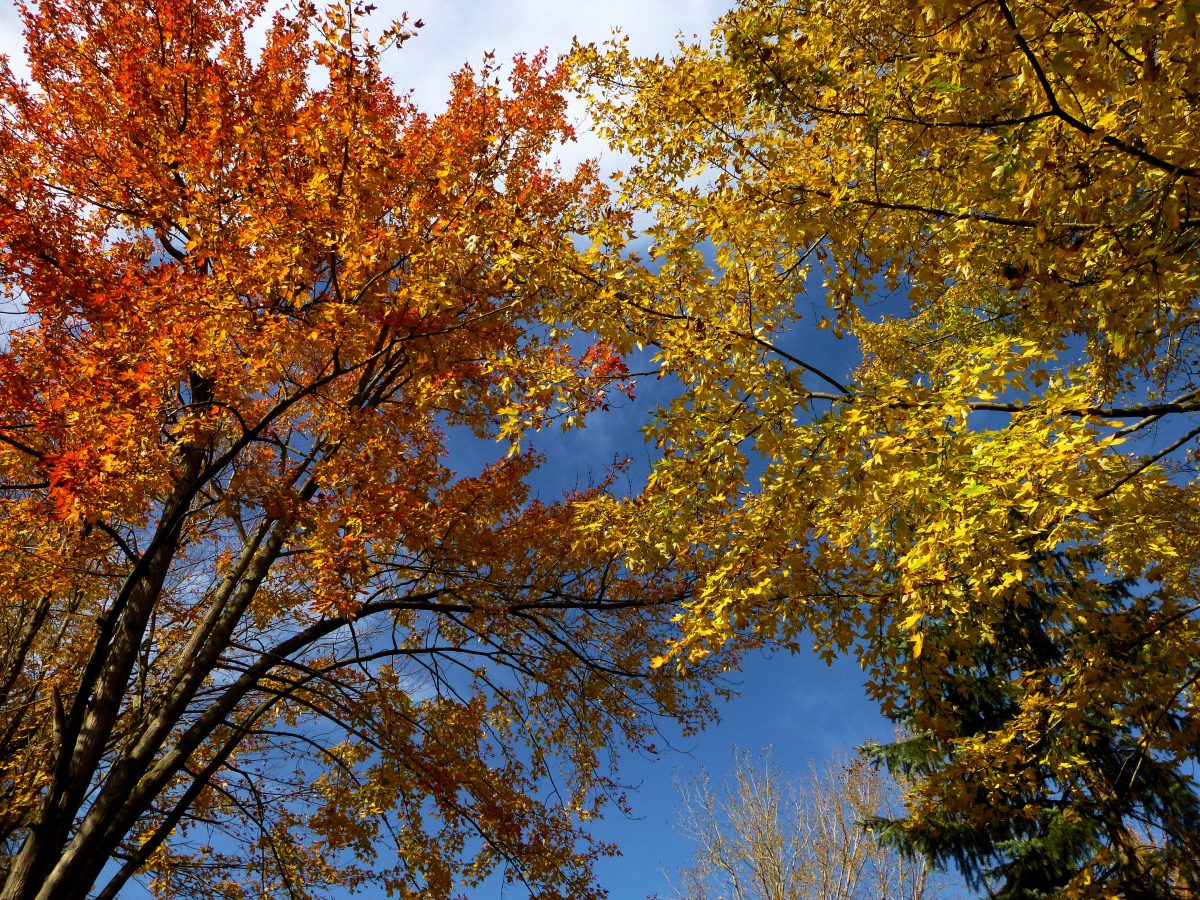
fall color in the trees
Gift article.
Why Leaving the Leaves Is Better for Your Yard
Keeping leaves in your yard can bolster the number and variety of species around — and the perks go beyond just the fall season.
Coming soon to a backyard near you: leaf drop. What’s your aftercare plan?
This fall, gardeners can turn to new research to inform their decisions on how to manage the cleanup — whether or not to “leave the leaves,” as the ecologically focused rallying cry has been in recent years.
That campaign has spread awareness that fallen leaves provide overwintering habitat for many ecologically critical organisms. But that’s not all they do. Now, we can look at theconsequences of leaf removal by the numbers, data that makes a more nuanced case for a gentler approach that supports plants and soil, and also offers insights into the most effective how-to practices to employ.
The effects of leaf removal were the subject of a two-year study published in March by Max Ferlauto, state entomologist for the Maryland Natural Heritage Program, and Karin T. Burghardt, an ecologist and associate professor at the University of Maryland.
From mid-March to late June each year of the study, the researchers set up traps of fine mesh netting on frames above test areas where leaves had been left in place and others where they had been removed. They then identified and counted what organisms emerged from each, comparing results.
“We actually have a lot more things emerging than I think many homeowners think we do,” Dr. Ferlauto said. “In a square meter of yard where you leave your leaves, there’s on average almost 2,000 insects that will emerge over the course of the spring.”
That total number doesn’t include decomposers and detritivores like earthworms or millipedes, he said, nor the tiny insectlike soil animals called springtails. What it does include are arboreal arthropods — species that spend only a portion of their lives in the fallen leaves and the rest above ground: butterflies and moths (about 20 will emerge), parasitic wasps (about 300), beetles (almost 400), more than 100 spiders and 1,000-plus flies of various kinds.
Rake up or blow away those leaves, or shred them with your mower, and the results plummet — as do the essential ecological services those organisms perform, including key pest-control roles by the spiders, parasitic wasps and certain beetles.


“When you remove the leaves, instead of retaining them,” Dr. Ferlauto said, “you reduce the number of moths by 45 percent, the number of spiders by 56 percent on average, the average number of beetles by 24 percent.”
Besides those declines in abundance — the total number of individuals — there was also a reduction in species richness, the diversity within each group. In butterflies and moths, for example, that fell by 44 percent.
Dr. Ferlauto highlighted key takeaways for gardeners to consider while making fall plans.
Shredding leaves on site is as costly to the lives in them as removing leaves from your property.
Removing leaves, Dr. Ferlauto said, can affect overwintering insects in two ways: “You could literally be destroying them,” he said, “or you could be changing their microhabitat such that they don’t survive.”
Image

He added: “The number one thing you can do from an entomologist’s perspective is plant an oak tree and leave the leaves that fall off the oak tree.”
It’s not coincidental that this viewpoint echoes that of Douglas W. Tallamy, an entomologist at the University of Delaware who is outspoken on the power of oaks: Dr. Tallamy and Dr. Burghardt, who, along with being the study’s coauthor, was Dr. Ferlauto’s Ph.D. adviser, have published research together.
Dr. Ferlauto understands that retaining all leaves isn’t always practical, and that even gardeners who are inclined to keep some have questions about the optimal method of doing so.
“Removing and shredding are equally bad,” he said, “but if you have to rake your leaves, moving them to another location is OK.”
Rake and relocate whole leaves — and not just to some out-of-the-way area like behind a shed, Dr. Ferlauto said. Resources probably already exist in such unmanaged spots; instead, for maximum benefit, transform a mowed or otherwise maintained spot by leaving leaves there instead, or moving some into place.
“What we think is happening is by offering that resource that wasn’t there in the past, you’re attracting insects to that leaf area,” he said. “These insects are almost in a desert, and a lot of them have a wandering phase, trying to find a place to overwinter. By preserving leaves in a section of that more maintained area, you’re kind of providing that shelter they otherwise wouldn’t have.”
To identify areas you can transition to this management style, he suggested considering where insects that were attracted to your pollinator garden or native host plants will spend the rest of their life cycle. Can you create a habitat for other seasons nearby?
“Maybe you have a tree in your front yard that you could rake your leaves under, as opposed to mowing them or raking them off completely,” Dr. Ferlauto said.
Additionally, he suggested using some relocated leaves as a mulch in existing beds elsewhere, which also can reduce dependency on inputs like bagged mulch.
Composting can kill the inhabitants of fallen leaves, too.
Though it is often recommended that rather than cart leaves in bags to the curb, we compost them — an approach that does reduce what goes to the landfill — a well-managed compost pile achieves temperatures that will kill some organisms beneficial to your yard, Dr. Ferlauto said.
Even piling up the leaves, another oft-suggested tactic, can backfire.
“If your pile is too deep, the insects are not going to get the cues that they need to know when it’s time to emerge,” he said. “The energetic output they need to just get out of that leaf pile will reduce their survival.”
Leaves are essential habitat year-round.
Image

A lot of the focus in the “leave the leaves” campaign has been on not disturbing overwintering areas, which may have prompted the thought that a light fall cleanup could allow for a more rigorous one in spring without harm.
Despite recommendations gardeners may have heard to delay cleanup until after a stretch of 50-degree days in spring, or when the soil temperature reaches a certain point, “that’s really just not what we’re seeing,” Dr. Ferlauto said.
The research found no moment of peak of emergence, a point after which all the insects were gone. In fact, it only increased as spring became summer, he said.
“Leaves have fallen for millions of years, so of course plants and animals have come to expect or even rely on them to complete their life cycles,” said Rebecca McMackin, the lead horticulturist for the American Horticultural Society. “It’s our job as ecological gardeners to figure out how to incorporate these natural processes into our landscapes in ways that are both functional and beautiful.”
Years of leaf removal also degrades the soil.
Research published last year, based on findings from the same yards as the Maryland study released this year, identified the presence of 24 percent less carbon in soils where traditional fall yard cleanup had been the longtime practice.
Soil carbon is a key to plants’ access to nutrition, and to the soil’s moisture-holding capacity, which is beneficial to plants and can also help prevent runoff.
Restoring the soil carbon is no quick fix, Dr. Ferlauto said.
“For insects, let’s say you leave leaves in your front yard for a year, we found an immediate restoration of that community; the insects bounce back,” he said. “But for soil carbon, it takes years to build that back up.”
Finally, don’t talk trash about fallen leaves.
Though it’s common to refer to fallen leaves as leaf litter, debris, detritus or even yard waste, the scientists deliberately avoided such negative terms throughout their report.
Instead, they simply referred to them as fallen leaves and in other neutral ways — or as an organic duff layer, evoking the ideal of the composition of an intact, diversity- and soil-sustaining forest floor.
Isn’t it time to give fallen leaves some respect for all the work they do?
**************************


 ~RAMBLING WOODS 2~
