
 Formed in 2009, the Archive Team (not to be confused with the archive.org Archive-It Team) is a rogue archivist collective dedicated to saving copies of rapidly dying or deleted websites for the sake of history and digital heritage. The group is 100% composed of volunteers and interested parties, and has expanded into a large amount of related projects for saving online and digital history.

A return to the light


Thanks to @palustris.bsky.social

A return to the light
Thanks to @palustris.bsky.social


Agar’s Gap

River names are considered the oldest and most enduring of all surviving place-names in Europe
Tees [Tesa 1026 Knytlinga saga, Tese c 1050, Tesa 1104-8, Teisa c 1090, Taise c 1130]. A Brit river-name related to Welsh tes ‘heat, sunshine’, Ir teas ‘heat’. The name may mean ‘boiling, surging river’. E Eckwall

Condatis
A group of dedications to a god whom we take to be local and indigenous occurs between the Tyne and the basin of the Tees. The name and situation (God of the Watersmeet) would tend to link the deity with the cult of thermal waters…The dedicants all seem to have been members of a rather humble order of society…names are suggestive of healers as a primary function, although we must not forget that war and healing are inextricably linked in the Celtic traditions. A Ross

Inscriptions
Bowes https://romaninscriptionsofbritain.org/inscriptions/731 discovered in 1900 close to the Roman Fort
High Coniscliffe https://romaninscriptionsofbritain.org/inscriptions/1024 found in 1709 but now lost
Moulton https://romaninscriptionsofbritain.org/inscriptions/Brit.47.1 found in an excavation pit during A1 upgrade in 2015
Chester le Street https://romaninscriptionsofbritain.org/inscriptions/1045 discovered in 1886 beside the Cong Burn close its confluence with the River Wear
Cramond https://romaninscriptionsofbritain.org/inscriptions/3500 discovered in 1977 close to the roman fort at a point where the River Almond meets the Firth of Forth
Sources
The Concise Oxford Dictionary of English Place-Names. Eilert Ekwall. 1974.
Winch Bridge image – From the British Library Archive
Knut’s Invasion of England according to the Knytlinga saga
Pagan Celtic Britain – Studies in iconography and tradition – Anne Ross. 1967
Inscription image – Britannia Romana. J Horsley. 1732

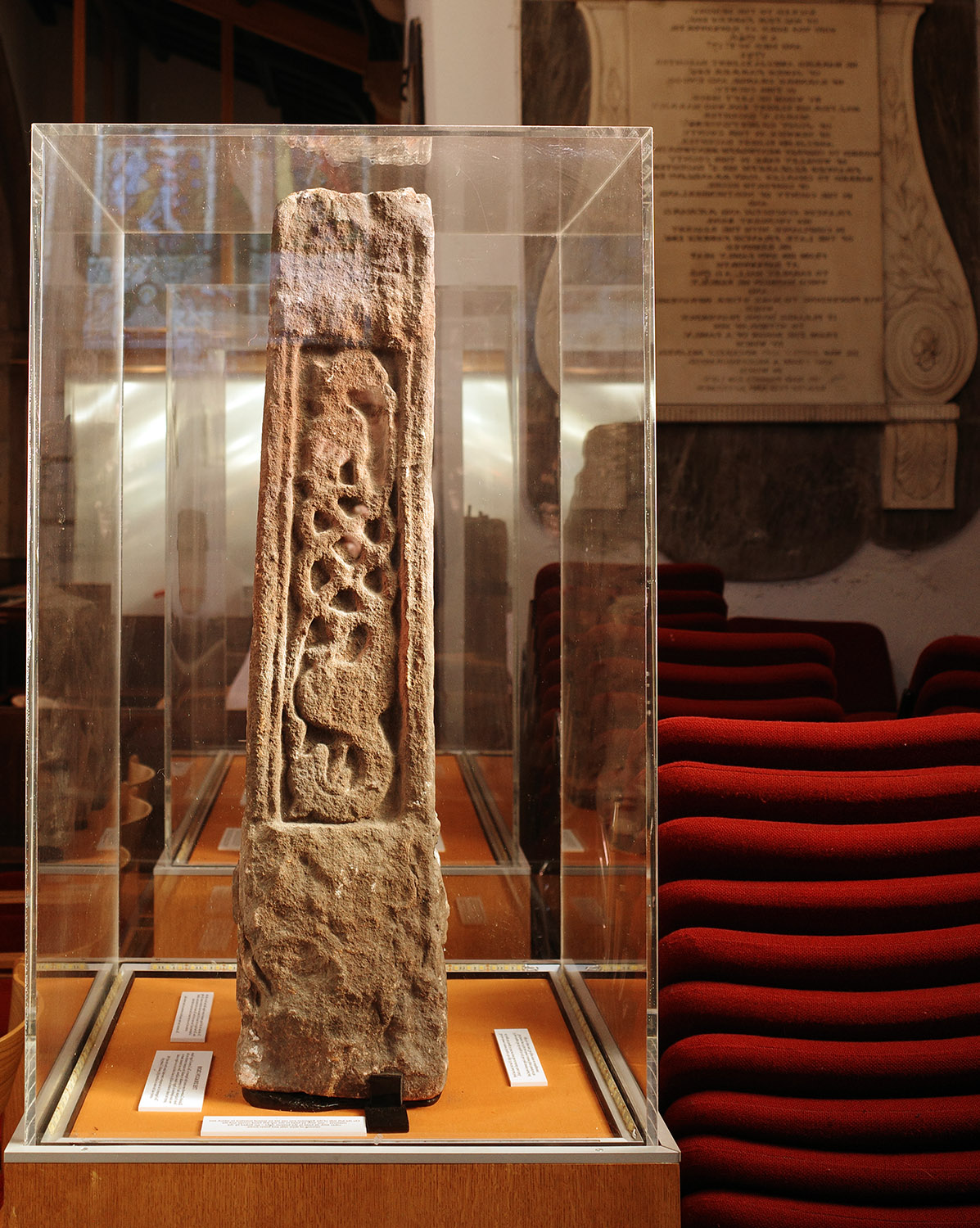


We called into the parish church to have a look at their display of early stonework fragments.

In the grounds of the church there is a large memorial known as The Navvies Memorial. It was originally erected it commemorate 23 workers who were killed during the construction of the Bramhope tunnel, later records show that the death toll was higher.

The monument has been repurposed to recognise all those who were injured or lost their lives building the 20,000 miles of railway track that covered our islands. It is unusual to find a monument that remembers working people. The ordinary people of our islands often only merit a grand memorial if they have been killed in war.
A trip to Ilkley normally involves wandering around Rombald’s Moor looking at Prehistoric carved rocks, but not today.

William Mitchell’s 1968 sculptural mural ‘The Story of Wool. The Bronze-faced glass reinforced plastic (GRP) is located on lecture theatre of the former technical centre of the International Wool Secretariat in Ilkley.


.“..they have a tradycon that the Danes used to land there, showinge greate heapes of huge Dunes in the sands, in length little exceeding ours, but in strength and bigness gyant lyke, whether they had gotten a cruste or noe, or that there were some charnell-house there I knowe not, wich I suspecte by a reason that a Chapell, one of three built by three sisters, aIong that coaste is neere at hand”. Link


Beyond the pale
Winter


 The Smell of Water