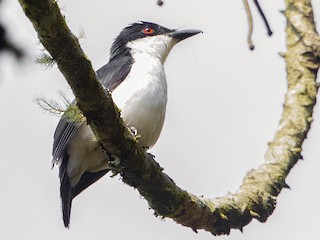
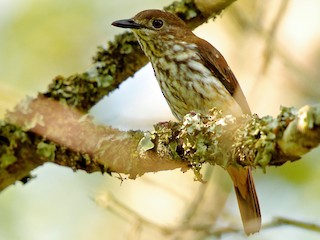
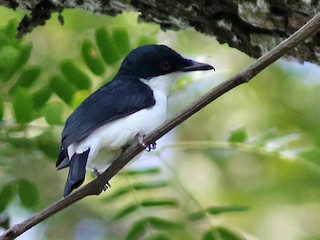
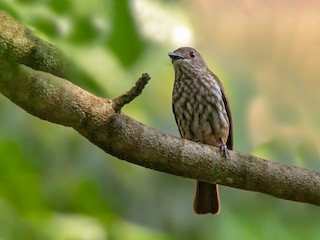
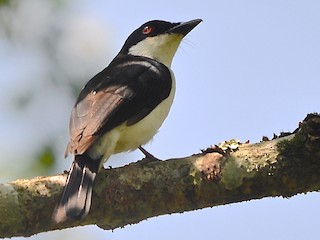
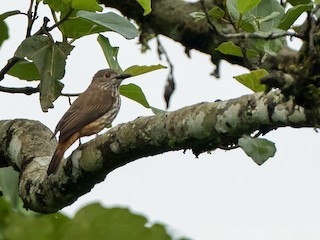
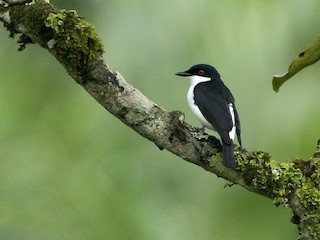
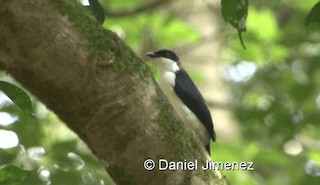

African Shrike-flycatcher Megabyas flammulatus Scientific name definitions
- LC Least Concern
- Names (23)
- Subspecies (2)
Michel Louette
Version: 1.0 — Published March 4, 2020
Text last updated January 22, 2013
Text last updated January 22, 2013
Sign in to see your badges
Species names in eBird-supported languages
| Language | Common name |
|---|---|
| Bulgarian | Африканска сврачкова мухоловка |
| Catalan | bies de carpó blanc |
| Croatian | afrička vanga |
| Danish | Monarktornskade |
| Dutch | Witstuitklauwier |
| English | African Shrike-flycatcher |
| English (AVI) | African Shrike-flycatcher |
| English (Kenya) | Shrike Flycatcher |
| English (United States) | African Shrike-flycatcher |
| French | Bias écorcheur |
| German | Schnäppervanga |
| Japanese | タンビヒタキ |
| Norwegian | hvitbrystbias |
| Polish | kongowczyk białogardły |
| Portuguese (Angola) | Papa-moscas-picanço |
| Russian | Огнеглазая сорокопутница |
| Serbian | Afrička svračkolika muharica |
| Slovak | pláštenkár červenooký |
| Spanish | Bias Llameante |
| Spanish (Spain) | Bias llameante |
| Swedish | vitbröstad monarktörnskata |
| Turkish | Sinekkapan Vanga |
| Ukrainian | Біас великий |
Megabyas flammulatus Verreaux & Verreaux, 1855
PROTONYM:
Megabyas flammulata
Verreaux & Verreaux, 1855. Revue et Magasin de Zoologie Pure et Appliquée (2), 7, p.348.
TYPE LOCALITY:
'Riviere d'Angers' = Muni River, Gabon.
SOURCE:
Avibase, 2025
Definitions
- MEGABYAS
- flammulata / flammulatum / flammulatus
The Key to Scientific Names
Legend Overview
UPPERCASE: current genus
Uppercase first letter: generic synonym
● and ● See: generic homonyms
lowercase: species and subspecies
●: early names, variants, misspellings
‡: extinct
†: type species
Gr.: ancient Greek
L.: Latin
<: derived from
syn: synonym of
/: separates historical and modern geographic names
ex: based on
TL: type locality
OD: original diagnosis (genus) or original description (species)
Originally Appeared in

Full content is available exclusively to Birds of the World subscribers. Sign in Learn more
Introduction
Subspecies
SUBSPECIES
Megabyas flammulatus flammulatus Scientific name definitions
Distribution
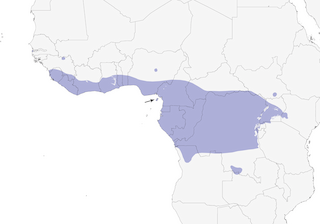
forests from Guinea and Sierra Leone E, including Bioko and C Nigeria (Jos Plateau), to W DRCongo.
Megabyas flammulatus flammulatus Verreaux & Verreaux, 1855
PROTONYM:
Megabyas flammulata
Verreaux & Verreaux, 1855. Revue et Magasin de Zoologie Pure et Appliquée (2), 7, p.348.
TYPE LOCALITY:
'Riviere d'Angers' = Muni River, Gabon.
SOURCE:
Avibase, 2025
Definitions
- MEGABYAS
- flammulata / flammulatum / flammulatus
The Key to Scientific Names
Legend Overview
UPPERCASE: current genus
Uppercase first letter: generic synonym
● and ● See: generic homonyms
lowercase: species and subspecies
●: early names, variants, misspellings
‡: extinct
†: type species
Gr.: ancient Greek
L.: Latin
<: derived from
syn: synonym of
/: separates historical and modern geographic names
ex: based on
TL: type locality
OD: original diagnosis (genus) or original description (species)
SUBSPECIES
Megabyas flammulatus aequatorialis Scientific name definitions
Distribution
forests of C DRCongo, N Angola and Uganda, and very locally S South Sudan (Bengangai), NW Tanzania (Minziro Forest), and W Kenya (Kakamega and Nandi Forests); disjunctly S DRCongo (Kasaji, in Katanga) and neighbouring NW Zambia (Mwinilunga district).
Megabyas flammulatus aequatorialis Jackson, 1904
PROTONYM:
Megabias aequatorialis
Jackson, 1904. Bulletin of the British Ornithologists' Club 15, p.11.
TYPE LOCALITY:
Entebbe, Uganda. Type from Kazi, Murchison Bay, Lake Victoria, fide Jackson and W. L. Sclater, 1938, Birds Kenya Uganda, p. 920.
SOURCE:
Avibase, 2025
Definitions
- MEGABYAS
- flammulata / flammulatum / flammulatus
- aequatoriale / aequatorialis
The Key to Scientific Names
Legend Overview
UPPERCASE: current genus
Uppercase first letter: generic synonym
● and ● See: generic homonyms
lowercase: species and subspecies
●: early names, variants, misspellings
‡: extinct
†: type species
Gr.: ancient Greek
L.: Latin
<: derived from
syn: synonym of
/: separates historical and modern geographic names
ex: based on
TL: type locality
OD: original diagnosis (genus) or original description (species)
- Year-round
- Migration
- Breeding
- Non-Breeding
Distribution of the African Shrike-flycatcher